It will be easier said than done, but he’s going to try
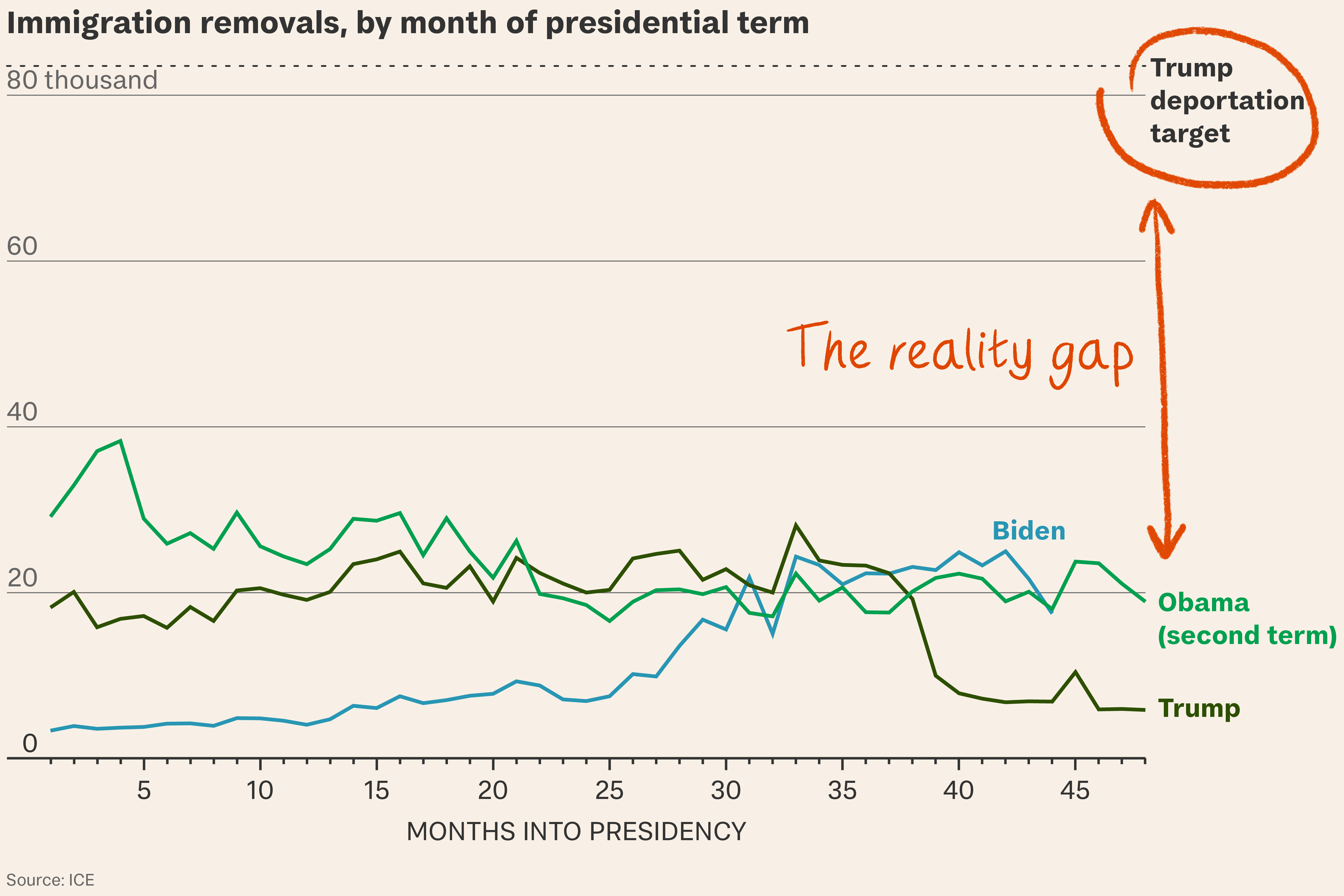
Before last year’s election Donald Trump vowed to carry out the biggest mass deportations in American history, targeting millions of undocumented immigrants from day one of his presidency.
So what? It’s day three and since his inauguration Trump has already declared a national border emergency, tasking the federal military with enforcement duties for the first time. That may be subject to legal challenge but he has also
- ordered federal agencies to restore his ‘Remain in Mexico’ policy, which forces migrants to wait there until their immigration case comes to court;
- shut down the CBP One entry programme, effectively removing the only legal route to asylum in the US; and
- signed an order to end birthright citizenship, which is enshrined in the constitution and would require a two-thirds majority in Congress to change.
Twenty-two Democrat-led states have already sued to block the birthright citizenship ban, but no one is arguing Trump didn’t win a mandate to get tough on immigration.
A little history. Starting in 2021 the Biden administration rolled back border restrictions from the first Trump term that had outraged progressives, not least by separating migrant children from their parents. Border crossings under Biden peaked in December 2023 at 250,000, boosted by unrest in Venezuela. Swing state Democrats and Biden himself urged tougher action sooner, but when he presented Congress with a border security package in February 2024, Republicans voted it down on Trump’s instructions to deny Democrats a win.
In practice. Few believe Trump’s mass deportation goal is achievable as promised. Even trying to reach it will cause significant disruptions to
- the lives of immigrants – 11 million are estimated to live in the US undocumented and most have done so for more than a decade; and
- the industries that depend on them – undocumented workers represent 6 per cent of America’s labour force and are especially important to the agriculture, healthcare, construction and hospitality sectors.
“I’m worried because I’m someone that’s undocumented,” a Mexican immigrant living in Georgia told Tortoise. “I have children who are American citizens because they were born here – what does that mean for my kids?”
More than four million US-born children live in a household with at least one unauthorised immigrant parent, according to the Pew Research Center.
First on the list. Mainly due to policies introduced under Biden in cooperation with Mexico and South American countries, the volume of arrivals at the southern border is lower than in years.
So Stephen Miller, Trump’s homeland security adviser, and his border czar, Tom Homan, will likely start inside the country. They could target
- the one million or so Venezuelans, Nicaraguans, Haitians and Cubans who entered the US in recent years through a “humanitarian parole” programme for refugees; and
- those with criminal convictions, despite evidence showing immigrants commit crimes at much lower rates than those born in the States.
Heavy lift. Every aspect of a mass deportation operation is complicated, says Doris Meissner of the Migration Policy Institute. The marshalling of detention space, government personnel, legal services and local law enforcement would “require a much more significant dialling up of federal government resources” than previous operations.
It would be expensive too.
- Employment would fall – deporting 1.3 million workers could cause a 1.1 per cent decline in overall employment by 2028, as business owners shift to less labour-intensive technologies.
- Production too – particularly in the agriculture sector where more than half of farmworkers are undocumented migrants.
- Inflation would rise – without low-wage labour provided by undocumented workers inflation would not have fallen as it did in the middle six months of last year.
“The likelihood of mass deportations at the level that Trump describes is quite low,” says Meissner, “but he will dramatically change the way interior enforcement has been done, which is already causing fear and uncertainty.”
What’s more… That uncertainty is being felt south of the border too. By Monday evening would-be migrants checking their phones were reading that existing asylum appointments “have been cancelled”.