
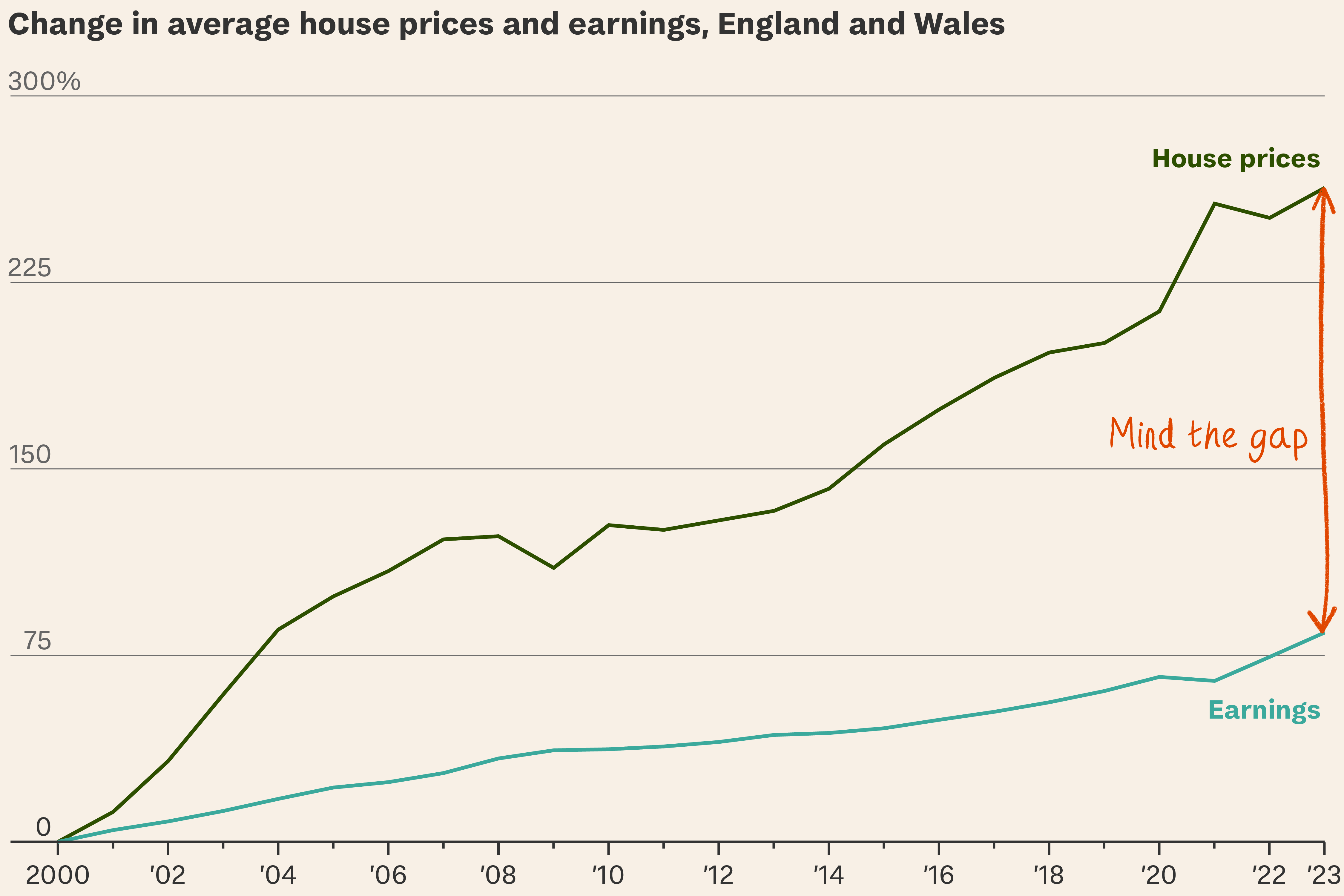
Hours before King Charles entered parliament yesterday to announce the Labour government’s proposed new laws, new figures were released showing UK house prices had risen again. Rents climbed even higher.
So what? They have to come down. Labour's entire domestic agenda depends to a large extent on
- unlocking growth
- by lowering housing costs
- by boosting housing supply
- by forcing through planning reforms in parts of the country and government that have resisted them for decades.
Right idea. Keir Starmer has won qualified approval for taking a “how, not if” approach to building more homes. Average UK house prices have risen by 34 per cent since 2007 – faster than real wages, consuming more of average earnings, leaving less for food, leisure, consumer goods and savings, and hurting productivity.
UK productivity growth averaged 0.2 per cent a year between 2007 and 2019. It has continued on a similar trajectory since the pandemic, and is estimated to be around 16 per cent behind comparable countries like the US, France and Germany.
We have been here before. Successive governments have tried to build more homes, just as they have tried to solve the UK’s 15 year-plus productivity puzzle. None so far has succeeded. That doesn’t mean Starmer can’t.
P / H sauce. The finger of blame for slack UK growth is increasingly being pointed at sclerotic planning laws in general, and housing in particular.
On average, Brits spend 26 per cent of their income on housing.
In London, it’s more like 30 per cent. Unusually, the UK capital is the country’s financial, political and cultural hub, concentrating jobs across multiple sectors into a few miles, forcing up house prices and creating a vicious circle in which workers are squeezed into smaller dwellings or priced out of living near high-wage jobs – and businesses can’t attract the best staff at wages they can afford.
But it’s not just a London problem:
- Oxford and Cambridge have prohibitively high house prices that are throttling nascent tech industries. In 2017 a report found that doubling house building in the Oxbridge ‘corridor’ would increase gross value added by £163 billion. Plans for development were announced by the Tory government, then shelved.
- Bristol, another affluent university city, is highlighted by think tank Centre for Cities as one of the worst affected areas, where restrictive planning rules on green belt development have forced house prices up to 13 times incomes, compared with 8.3 nationally.
- George Osborne’s Northern Powerhouse initiative was designed to better connect northern university towns, create jobs and boost productivity. But after 13 years, schemes like HS2 and the Transpennine Route upgrade have been delayed, cut back or scrapped.
Starmer’s alternative. His Planning and Infrastructure Bill would, among other things, reintroduce mandatory housebuilding targets for local authorities, boost planning capacity and reform the compulsory purchase order process to speed up land buying for new homes.
Attack of the Nimbys. The last Conservative government missed its pledge to build 300,000 homes a year by around 70,000. Former Housing Secretary Michael Gove vowed to break the logjam, but backed down to rebels in his party who objected to building in their proverbial back yards.
Labour has the same target of 300,000 homes a year – 1.5 million over the five-year parliament or nearly 1,000 a day. It has Nimbys of its own (as do the Greens, who this week had to defend their co-leader after he called for a pause on plans to erect electricity pylons carrying wind-generated electricity).
And yet there are signs that markets believe Starmer’s promises of change:
- As those promises were trailed over the past year, shares in the UK’s six biggest housebuilders rose in value by an average of 50 per cent.
- They gave up 1 per cent of that yesterday as analysts complained of a lack of detail in the King’s Speech, but it’s clear Starmer feels he has to seize the day on planning reform to have any chance of a second Labour term.
What’s more… he has no shortage of advice. UK Day One, a think tank, proposes a new town for up to 350,000 people at the junction of the East Coast Mainline and a revived Oxford-to-Cambridge rail link. To which one X user responds: “Well done lads, you’ve invented Bedford.”