
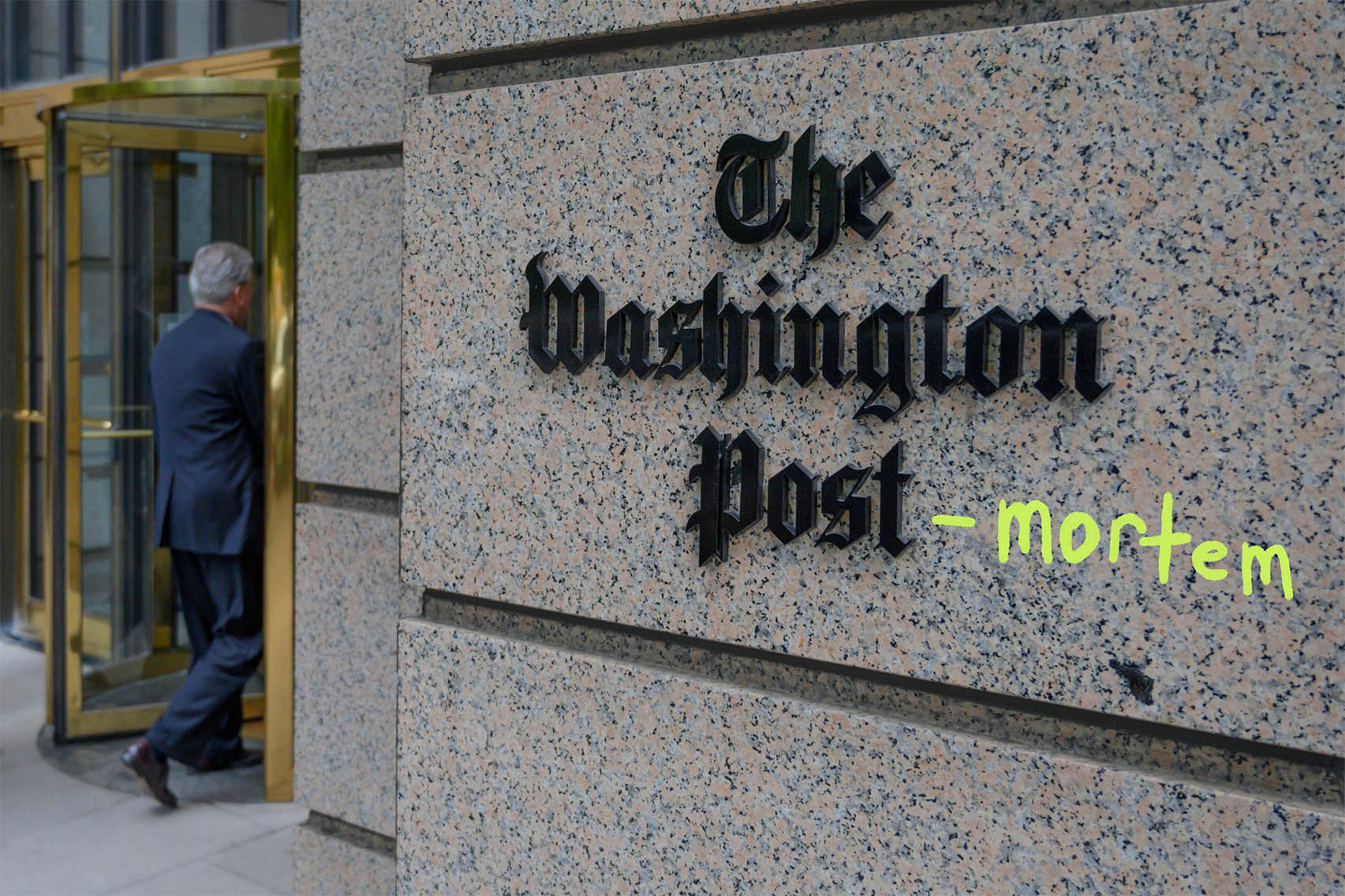
Will Lewis has big ideas, none of which will fly if staff don’t get behind them.
Last Sunday the Washington Post’s British CEO emailed staff to say their editor was being replaced by another Brit. On Monday he told them in person he wasn’t going to sugarcoat their situation: “People are not reading your stuff.”
So what? This is the paper of Watergate, Woodward and Bernstein; an icon of American journalism and the local paper of the most powerful capital city on Earth.
None of that is helping. The Post has been haemorrhaging money and readers despite lavish investment from Jeff Bezos, founder of Amazon and the world’s second richest person.
That the Post is “lost at sea,” as one staffer put it this week, prompts questions about
- the future of the news business, if it has one;
- why so many British editors have been hired over local talent in the land of the First Amendment; and
- what the new crew at the Post might do with it, and what they represent.
There’s also a question about timing: Sally Buzbee resigned as the Post’s executive editor soon after publishing an article against the advice of her CEO, Will Lewis. The piece was about phone hacking in the UK, and it mentioned him in connection with a past job as an executive for Rupert Murdoch.
Three bad years. Bezos – net worth $202 billion – bought the paper in 2013. In his first seven years as owner it shed staff, gained subscribers (Trump’s first presidency helped) and clawed its way to profit. Then, according to the paper’s former editor Marty Baron, interest in politics collapsed because Biden was dull after Trump; and so did digital ad revenue.
The Post has lost half its readers and half a million subscribers since 2020.
It lost $77 million last year alone, compared with $71 million in profits for its rival, the New York Times.
A largely British coup. Before Buzbee was named the paper’s first woman executive editor, Bezos insisted on a series of interviews for each of several candidates, ending in each case with dinner at his DC home. The idea was that he would get to know them. As far as anyone can tell there was no such process before Sunday’s announcement by Lewis that Buzbee was going.
Chums. Challenged by one of his reporters on whether he’d interviewed any women or people of colour in his search for her replacement, Lewis said the process had been “iterative and messy”. If so it seems the net was not cast wide.
- Buzbee has been temporarily replaced by Matt Murray, an ex-colleague of Lewis’s from the Wall Street Journal.
- He’ll be replaced after the US election by Robert Winnett, an ex-colleague of Lewis’s from the Telegraph.
Culture. Post staff are worried about diversity, but the men parachuted in to run the paper made famous under Ben Bradlee represent a challenge to its culture too.
- Winnett ran the Telegraph’s coverage of the MPs’ expenses scandal in the UK after Lewis paid a reported £110,000 for the source material – not something most US journalists would seriously consider.
- Lewis, given a knighthood by Boris Johnson for “political and public office”, later set up the News Movement in New York, with a business model based on selling bespoke short videos to commercial clients like Amazon.
- He left Post staff scratching their heads on Monday with a new emphasis on “service” and “social” journalism. A senior source said that didn’t mean importing the News Movement model, but did mean more “utility journalism” on subjects like health and personal finance – and more TikToks.
Compatriots. In addition to the Post, Brits now run CNN (Mark Thompson), the Wall Street Journal (Emma Tucker), Bloomberg News (John Micklethwaite), the New York Post (Keith Poole) and the Daily Beast (Joanna Coles). Thompson also used to run the New York Times.
They can all be competent, ruthless and charming. That doesn’t mean they all have the deep understanding of America’s political geography needed to superintend meaningful election coverage in a country trying to fix and use its democratic institutions at the same time.
What’s more… Lewis had to do something to stop the losses at the Post, but he chose to assail his staff into the bargain: “I’ve listened to the platitudes,” he told them. “The game is up.” If he wants them to turn the news into something shinier to sell, it’s not clear they will oblige.


