

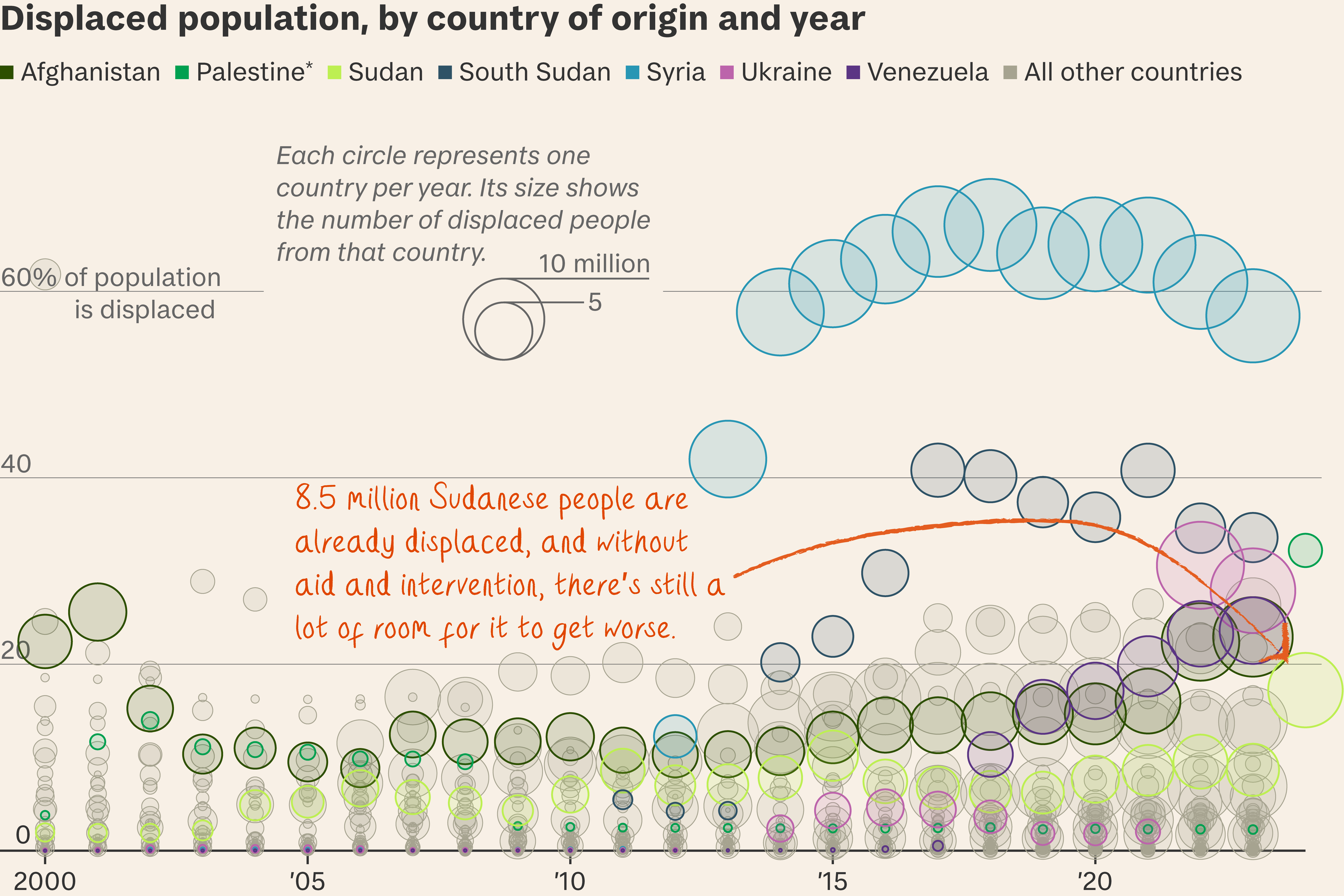
Donors at a conference in Paris have raised more than €2 billion for Sudan, including funds from the EU, France, Germany, the US and the UK.
So what? It’s about time. A year since the start of a conflict that took even the Sudanese by surprise, war has consumed a country five times the size of Germany. In the process it has
- put all Sudan’s seven African neighbours at risk of escalating violence;
- displaced 8.5 million people, with 1.8 million fleeing mainly to Chad, South Sudan and Egypt; and
- dashed hopes of a new era of democracy at the confluence of the Nile.
By the numbers
25 million – people in need of humanitarian assistance, nearly half the population, with nearly 5 million on the verge of famine
6 – factor by which the number of Sudanese entering Europe has grown since 2023
15,500 – people estimated killed in the war, which has injured almost 30,000 more
800,000 – children with severe malnutrition
5 – percentage share of the $2.7 billion needed to address Sudan’s humanitarian crisis this year that has actually materialised
Power play. The war started as a power-grab by the paramilitary Rapid Support Forces (RSF) for control of the capital, Khartoum. It has now become a civil war between the RSF and Sudan’s regular army (the SAF) with no discernible frontline, a complex ethnic history, multiple militias and wargaming from outside actors, with millions of Sudanese caught in the middle.
Today, the RSF controls most of Sudan, including
- Al Jazirah, which produces most of Sudan’s cereal crops;
- Darfur, where mass killings and displacement have led to extensive ethnic violence; and
- Khartoum, where large areas of the city have been destroyed.
“Since we lost Khartoum, the majority of the country is paralysed, from the telecommunication system, banking, governance, and our capability to respond with humanitarian assistance,” said Eatizaz Yousif, the Sudan country director for the International Rescue Committee.
Beyond Sudan. The UAE is believed to be supplying large quantities of military aid to the RSF via flights to neighbouring Chad. In addition:
- Ukrainian special forces are fighting the RSF and its Wagner Group backers;
- Russia is understood to be backing both sides; while
- Iran is reportedly providing its Mohajer-6 military drones to the Sudanese army.
Famine stalks the country and is expected to have taken hold in most of it by June, killing half a million people, according to a study by the Clingendael Institute, a Dutch think-tank. Behind closed doors, senior western officials are discussing a worst-case scenario of 10,000 deaths a day.
Harvests have been disrupted, cereal production has declined by almost half and the cost of food has soared. UN agencies struggle to reach 90 per cent of the areas most in need of aid as both sides use food as a weapon of war:
- RSF fighters regularly attack aid lorries and loot NGOs warehouses, while the SAF banned aid agencies from delivering supplies via Chad and continues to withhold travel permits for aid workers.
- There are logistical obstacles to reaching remote rural areas in Africa’s third biggest country, which is mostly desert, poorly served by roads.
What’s needed. Money and attention. Before this week, western governments had provided only a fraction of the cash needed to avert disaster.
- The crises in Europe and the Middle East have taken priority “but even before, there was no focus on Sudan,” says Zeinab Badawi, the Sudanese-born journalist and president of SOAS University of London.
- Delivering food aid to the region has become more expensive given difficulties in accessing wheat from Ukraine and running the gauntlet of Houthi attacks on Red Sea shipping.
The UN is seeking another $1.4 billion to help neighbouring countries that have taken in hundreds of thousands of refugees.
What’s more… Negotiation efforts to date have been uncoordinated and led by junior ministers, which makes them “invisible,” said Yousif. Sudan deserves better.
Postcards from America — by Mary Jordan and Kevin Sullivan

Women’s college basketball is smashing all kinds of audience records in the United States. The championship game last week drew more fans than baseball’s World Series and the venerable Master’s golf tournament. Its viewership topped men’s college basketball and pro NBA championship finals.
We were among the nearly 19 million people captivated by the rollercoaster game between the University of Iowa and the University of South Carolina. It was the first women’s basketball game we had ever watched from tip off to the final buzzer.
Like many other Americans, we caught this new fever because of 22-year-old Caitlin Clark from Iowa. She’s the highest-scoring player, male or female, in Division I college basketball history. Last month, she broke an all-time career scoring record that had stood since 1970.