
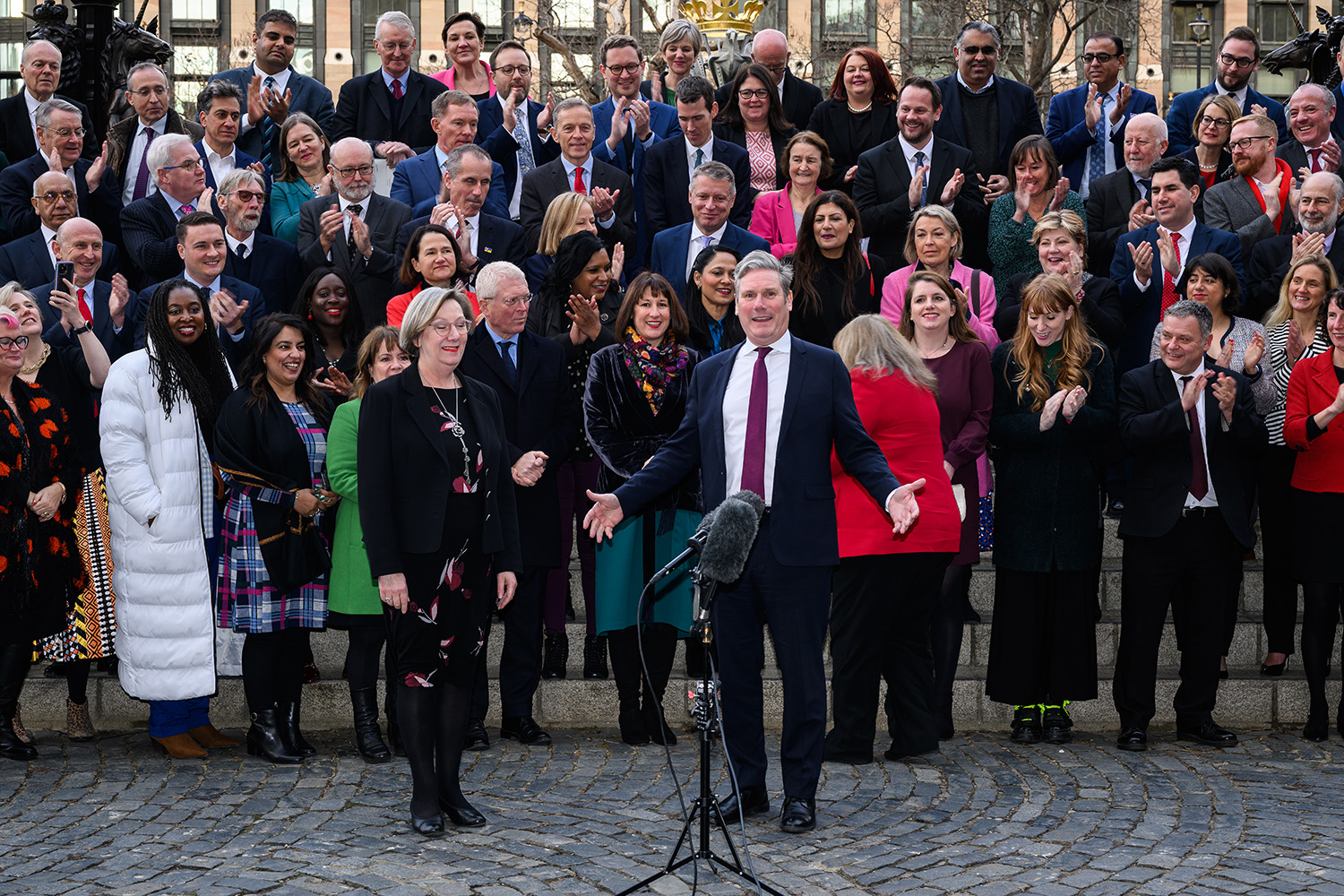
Hundreds of British MPs are effectively chosen not by voters but by six influential party managers and handfuls of local party activists. Meet the selectorate.
- Nagorno-Karabakh’s government said the breakaway state would dissolve on 1 January after its surrender to Azerbaijan.
- GB News suspended presenter Dan Wootton over sexist comments made on his show.
- A Nasa astronaut returned to Earth after getting stuck in space for a record 371 days.
In the space of a week the UK’s prime minister has shelved half a £100 billion high speed rail scheme, watered down an exemplary set of net zero targets, floated raising the inheritance tax threshold and allowed his home secretary to denigrate the UN’s 1951 Refugee Convention.
So what? These are carefully selected wedge issues, pushed onto the Downing Street news grid because Rishi Sunak is switching to campaign mode. Decision time looms for Britain’s voters, and thereby hangs a tale of the many and the few.
In principle, British voters choose their own MPs. In practice, they choose from a carefully scrutinised range of candidates handpicked by a small – sometimes tiny – cadre of party managers.
Meet the selectorate. Both main parties’ headquarters naturally want control over who stands in their name, but sources say
- Labour has become particularly centralised;
- a purge of the left by people around Keir Starmer is all but complete;
- the Conservatives give local party associations more say;
- and they’re ending up with relatively few women and ethnic minority candidates as a result.
Labour. Under Jeremy Corbyn, the Unite union dominated Labour’s selection process. These days, the power base has shifted to the party’s right.
Over the last 18 months Labour has selected more than 150 candidates for seats it considers winnable in 2024. Those calling the shots are:
- Matt Faulding, appointed by Keir Starmer to oversee the process and, having largely completed his work, recently promoted to secretary of the Parliamentary Labour Party;
- Matt Pound, special adviser to David Evans, Labour’s general secretary;
- Morgan McSweeney, Labour’s campaigns director; and
- Luke Akehurst who thanks to his place on the National Executive Council sits on many of the selection panels that send candidate shortlists to local constituencies.
Sources describe this group as “ruthless” in ridding Labour of leftwing candidates and anyone who might cause dissent. As Akehurst told Politics Home recently: “There is a political element to this… If we are in a very tight hung parliament situation, or very narrow Labour majority at the next election, I don’t want to have allowed people to have become Labour MPs who are not solid votes for the party.”
Challenged on whether that undermines the idea of Labour as a broad church, Akehurst said: “A [broad] church involves members of the congregation not burning the pews and throwing things at the vicar.”
Conservatives. The Tories’ key selectorati are
- Gareth Fox – CCHQ’s Head of Candidates, who’s led the process since 2010; and
- Greg Hands – the MP and party chairman, who’s said to be more involved than many of his predecessors.
Unlike Labour members, Tory members have to vote in person. That helps with transparency but it also means the final decision can be in the hands of as few as a dozen people. As of last September, total Tory membership stood at 172,000.
Sharp practice. MP selection isn’t always fair. Michael Crick, who runs the Tomorrow’s MPs account on X, says tactics range from creating shortlists tilted in the favour of chosen candidates to giving favourites a heads-up on key decisions before they’re made public.
Left. Crick estimates only five of Labour’s more than 150 new parliamentary candidates are from the left of the party.
Right. He says the Conservatives’ less controlled approach is resulting in the different problem of a scarcity of female and non-white candidates.
Safety in small numbers. The UK has 67 million people, 46 million voters and 650 House of Commons seats. The Tories’ safe seats look the safest: their 150 biggest majorities in 2019 were all over 17,000 (compared with 4,774 in Labour’s 150th safest seat in Putney) – a cushion unlikely to be wiped out even by a seismic swing to Labour. At a cautious estimate, half of Britain’s MPs will effectively be chosen not by voters but by the six people listed above and handfuls of local party activists.
Every vote counts, but some count more than others.


