Sensemaker Daily
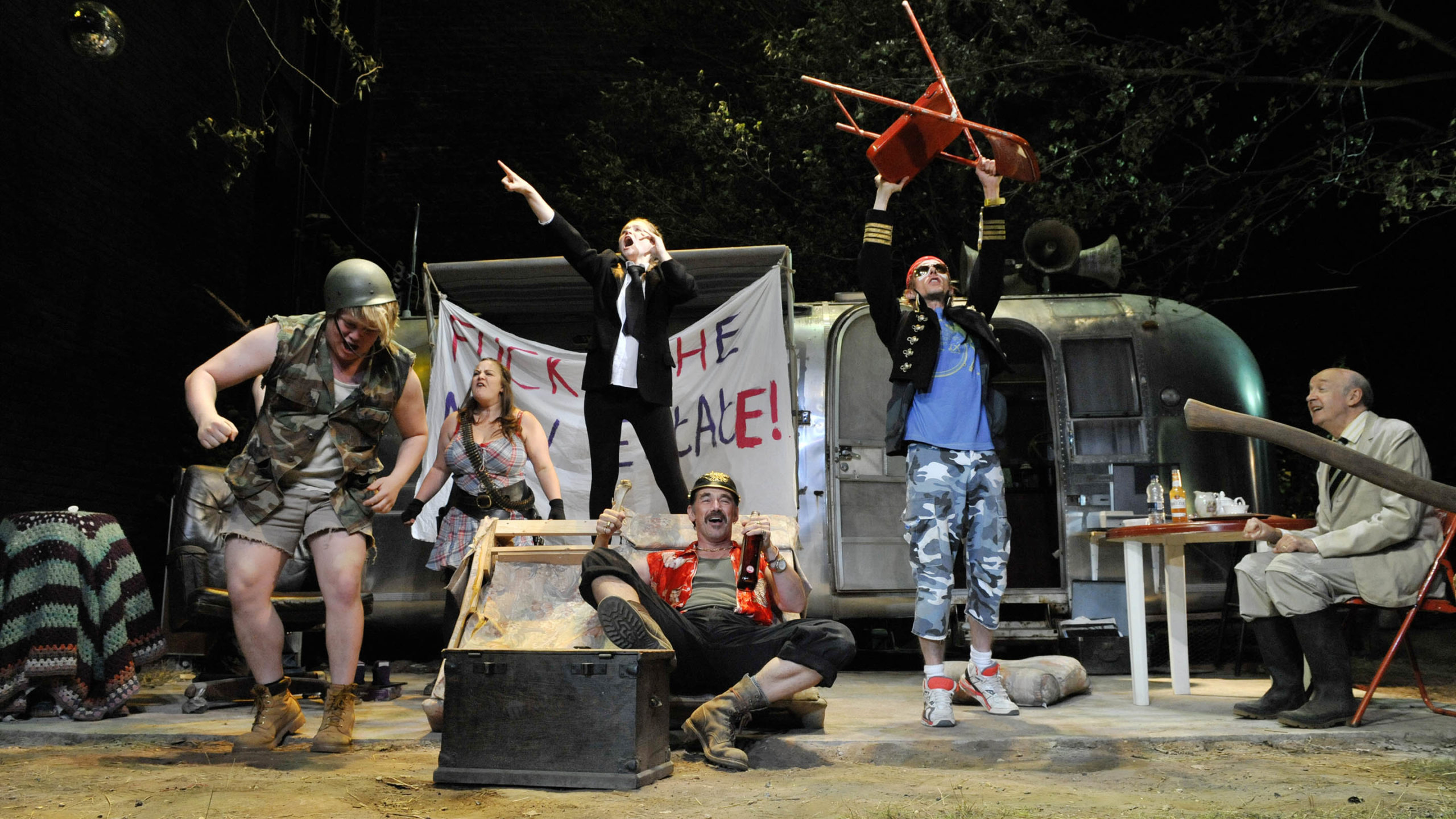
The return of Jez Butterworth’s Jerusalem – and Mark Rylance’s Rooster Byron – to London’s West End could not be more timely
“I doubt,” wrote Kenneth Tynan in May 1956, “if I could love anyone who did not wish to see Look Back in Anger.” I feel much the same about Jez Butterworth’s Jerusalem which, like John Osborne’s play, was first performed at the Royal Court Theatre.
Now, Ian Rickson’s great production is returning for its third London run (at the Apollo Theatre from 16 April, for only 16 weeks), with Mark Rylance reprising his towering performance as Johnny “Rooster” Byron and Mackenzie Crook at his side once more as Ginger Yates, a figure of baffled gentleness and a hilarious foil to Rooster.
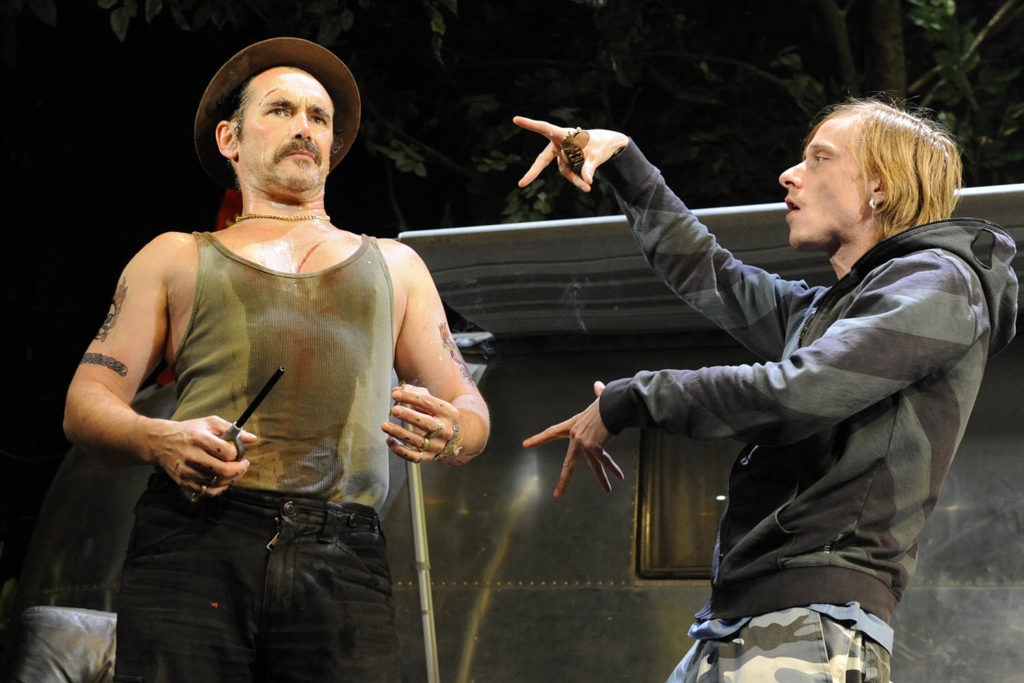
Jerusalem, which takes its title from William Blake’s poem is set on St George’s Day, as the Wiltshire village of Flintock – based on Pewsey, where Butterworth lived for a while – celebrates its annual fair. All the action takes place in a forest clearing where Rooster lives in a ramshackle mobile home, playing irascible host to a steady stream of visitors, selling them drugs and presiding, like a woodland lord of misrule, over a rolling series of raves and revels.
A former daredevil motorbike rider, he is a boozy, bucolic exile from convention and the constraints of regular citizenship; prowling the fringes of mainstream society, indomitable and pitiful by turns. Over the play looms the implacable force of bureaucracy and police power, as Rooster, after many narrow escapes, prepares for his final confrontation with the officials of Kennet and Avon council, whose absolute determination to evict him is matched by his absolute refusal to recognise their authority.
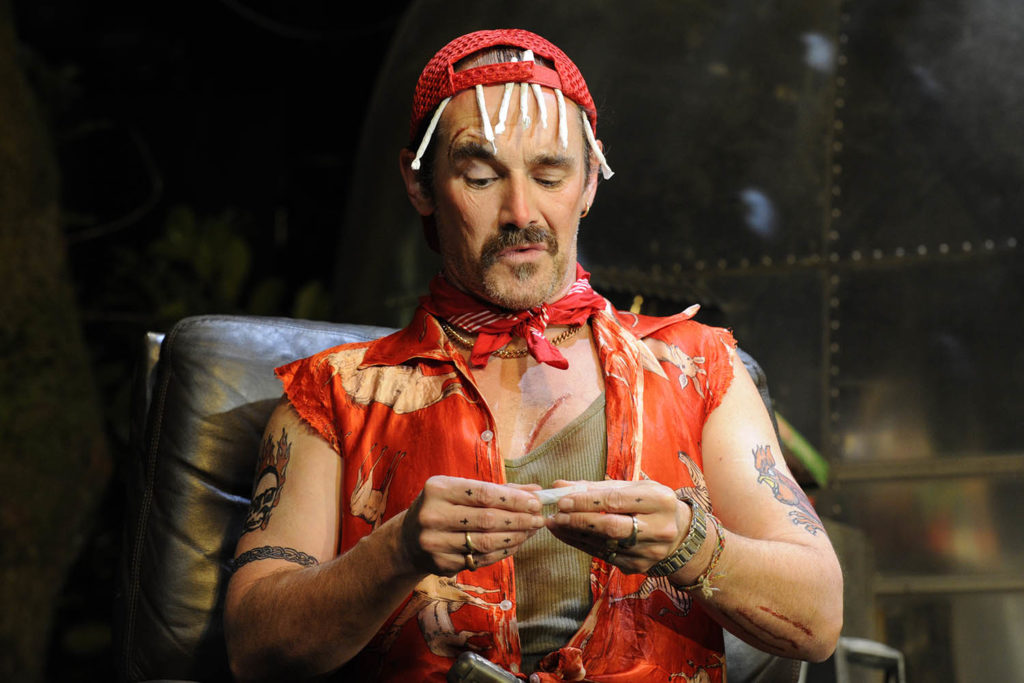
Almost his first words on stage are those of a free-born Englishman who, with humour, priapic fury and ancestral certitude, will not be shifted: “Hear ye, hear ye. With the power invested in me by Rooster Johnny Byron – who can’t be here on account of the fact he’s in Barbados this week with Kate Moss – I, his faithful hound Shep, hereby instruct Kennet and Avon to tell Bren Glewstone, and Ros Taylor and her twat son, and all those sorry cunts on the New Estate, Rooster Byron ain’t going nowhere. Happy St George’s Day. Now kiss my beggar’s arse, you Puritans!”
Much of the magic of Jerusalem resides in its intermingling of day-to-day life – the floats at the fair, the question of who is barred from which pubs and why, whether Rooster’s Lara Croft video game will work – with a deep sense of magic and myth. Byron claims nonchalantly to have “met a giant that built Stonehenge”, a 90-foot colossus who supposedly gave him his golden ear-ring as a drum – a means of summoning the mythic creatures of England in his hour of need. (Then again, he also mentions that he has been kidnapped by traffic wardens.)
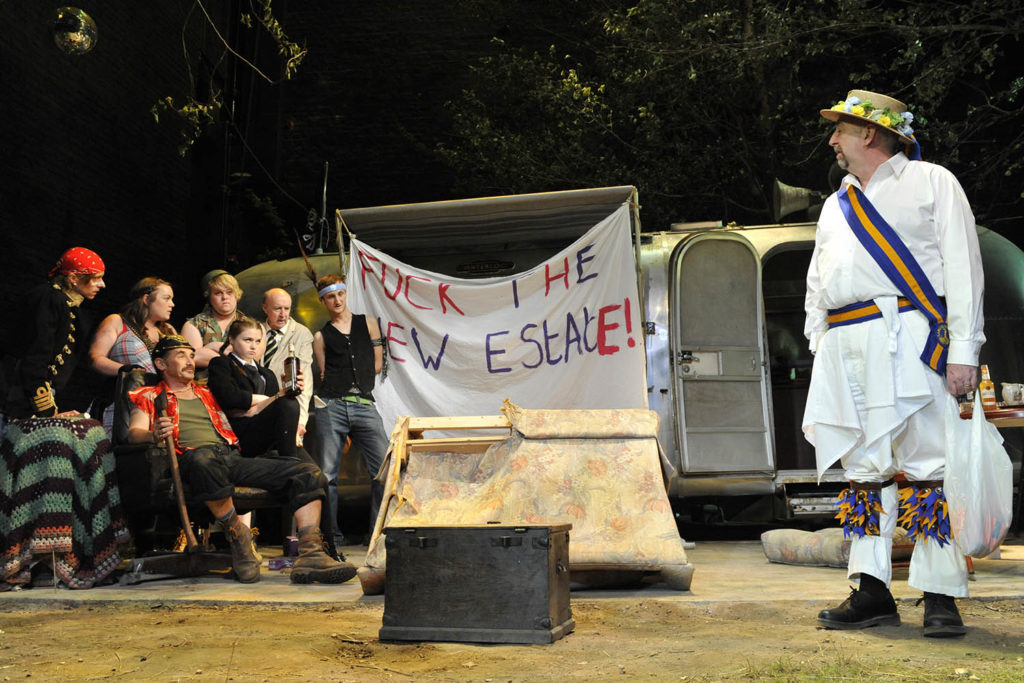
The eccentric, bewildered Professor to whom Rooster is always hospitable expresses his creed best: “It is an Englishman’s duty at the first scent of May to make the turf his floor, his roof the arcing firmament. And his clothes the leaves and branches of the glade… This is a time for revelry… To be free from constraint. A time to commune with the flora and the fauna of this enchanted isle. To abandon oneself to the rhythms of the earth.”
To the less tolerant inhabitants of the village – and the busybodies on the New Estate – Byron is nothing more than a debauched waster, a bad influence upon their children and an impediment to orderly progress. To those who gather in his clearing, he is a hot-tempered shaman, a master of festivities and a spinner of mystical yarns.
As Rylance has put it, Rooster speaks to the youthful desire to engage with mortal risk, to be “Jimmy Dean racing towards the cliff”. In this sense, the actor believes, he resembles the tribal figure who presides over initiation rituals; who “loves that moment when a young person flowers or becomes themselves for a bit.”
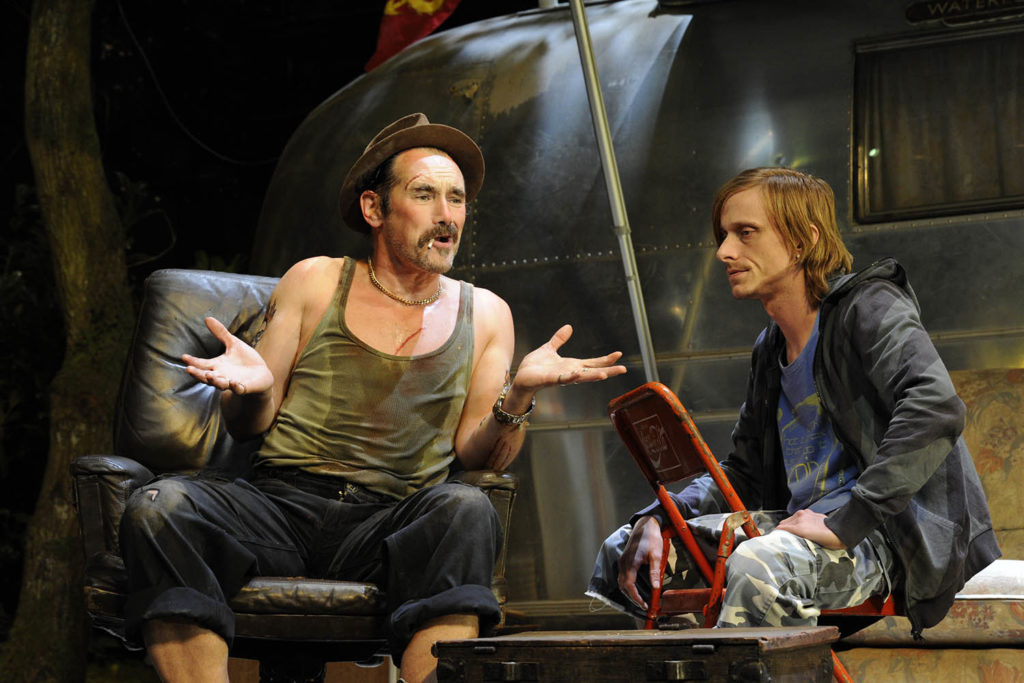
Butterworth, for his part, has always insisted that Jerusalem is “a play, not an argument”, that he did not set out to write “a pamphlet” or a “state of the nation” polemic. All the same, from its opening in 2009, his creation struck a deep chord – or many chords – in audiences, addressing yearnings, anxieties and dreams of which they may not even have been previously conscious. (Butterworth has referred to theatres as “churches”, where our fears and insecurities are given voice in a collective ritual experience.)
What did this response signify? Rylance’s Rooster was not so much the spokesman of a generation, in the style of Osborne’s Jimmy Porter, as a speed-enhanced national bard, reminding England of things it had lost and forgotten; excavating the English psyche on stage in outbursts that were both unsettling and exhilarating.
Thirteen years ago, it was natural to connect that sense of bereavement and dislocation to the seismic consequences of the financial crash, and the human wreckage it had left in its wake. The characters drawn to the clearing have low expectations and depleted hopes; you can see the beginnings of the gig economy in the work they mention. They cling to rituals such as the Flintock fair and the rolling Bacchanalia at Rooster’s place as a means of reminding themselves that they are alive, and that their lives have some form of meaning.
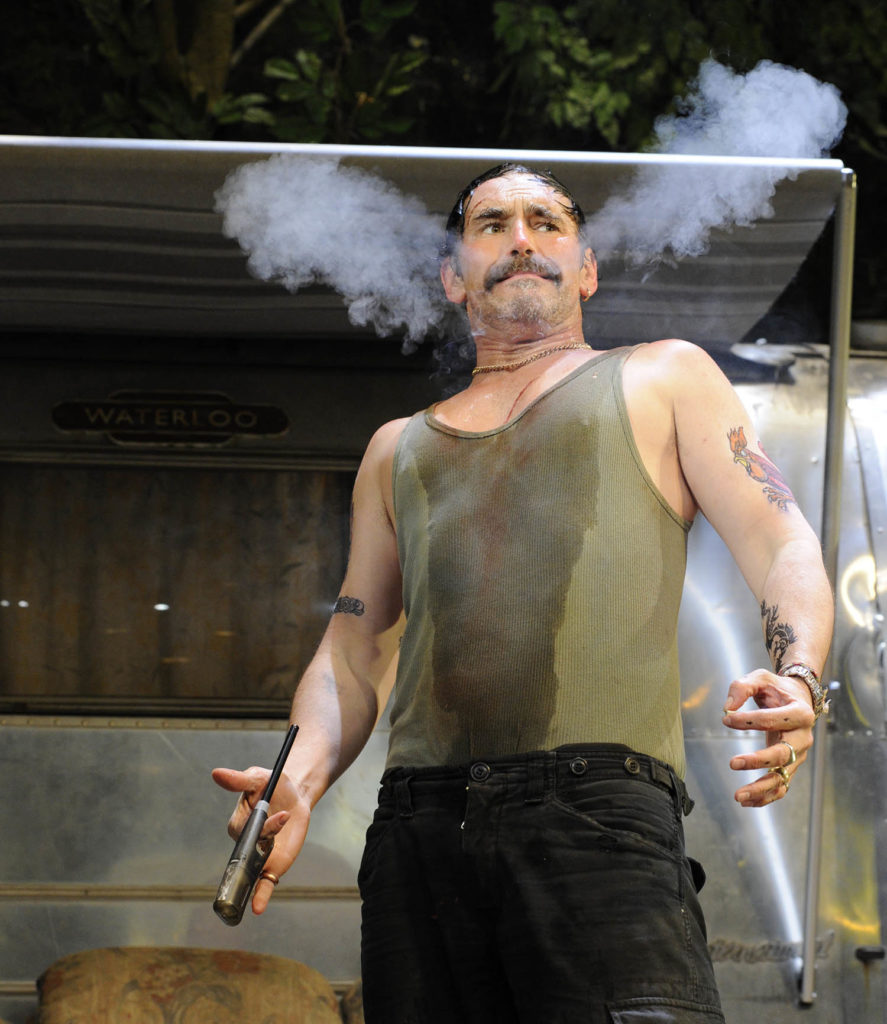
By October 2011, when the play returned to the West End after its triumphant run on Broadway, there had been riots in cities across England; scenes of conflagration, violence and looting. The demons that would later animate Brexit were beginning to stir in this patchy, unfocused rebellion against authority in all its forms. This time, the words of the play – the furies it unleashed and the spirits it summoned – seemed even more contemporary than they had in 2009.
Ten years since its last London performance in January 2012, Jerusalem must be watched and assimilated afresh, in a transformed social and political context. Much of the language and many of the ideas that it made so vivid a decade ago – the importance of place, of home, of tradition, of control over one’s life – have since been tarnished by the bitter experience of Brexit, of tawdry nationalism and of populist nativism.
Yet that is precisely why the play’s revival is so welcome. Butterworth’s lyrical, ironic and folkloric language is just what is needed now to detoxify the Englishness that is the bedrock of the play and to remind us of its value.

Jerusalem undoubtedly celebrates a certain kind of rootedness, a sense of belonging, community and mythic energy flowing from bloodlines and from the land. But there is nothing xenophobic or mean-spirited about the play. Rooster incarnates a gruffly welcoming sense of identity that is unconnected to ownership or borders. For all his complaints, he cares deeply about the “rats” – the wandering, wondering teenagers who cluster around him looking for fun, tall stories and the disinhibition of the dance. He is, indeed, the maypole around which they cavort.
Jerusalem in 2022 represents a reprieve for all that is best, most anarchic and most bawdily generous in the English soul. In fact, at a time when the nation is led by little, petty men, Rooster and his army of giants have never been needed more.


