A thumping Labour win could bring new demands for proportional representation.
If the polls are right, Thursday’s election in the UK will be a landslide for Labour. It could also result in millions of people being represented by only a handful of MPs from the party they backed.
So what? Trust in British politics is at an all-time low. But it may not end there. Disenfranchising people who voted for smaller parties could sow further discord and erode the remaining threads between voters and the political class.
A system designed to produce clear majorities and stable government could instead provoke
- a national argument about the state of representative democracy in the UK; and
- a concerted push for proportional representation from parties of the left and right.
Staging post. Under the UK’s first past the post system, each constituency is run as a distinct battleground and only a win counts. That means, theoretically, a losing party could have come second in every constituency, collating millions of votes, and yet have no MP to show for it.
That benefits bigger parties and disadvantages the smaller ones. In particular:
- Nigel Farage’s Reform party may end up with one or two MPs, despite current polling suggesting it could secure four or five million votes.
- The Green Party may have just one MP, despite being on course to win around a million votes.
- The Conservatives may win fewer than 100 seats, while
- Labour secures an historical victory despite winning fewer votes than under Jeremy Corbyn in 2017, when the party lost narrowly.
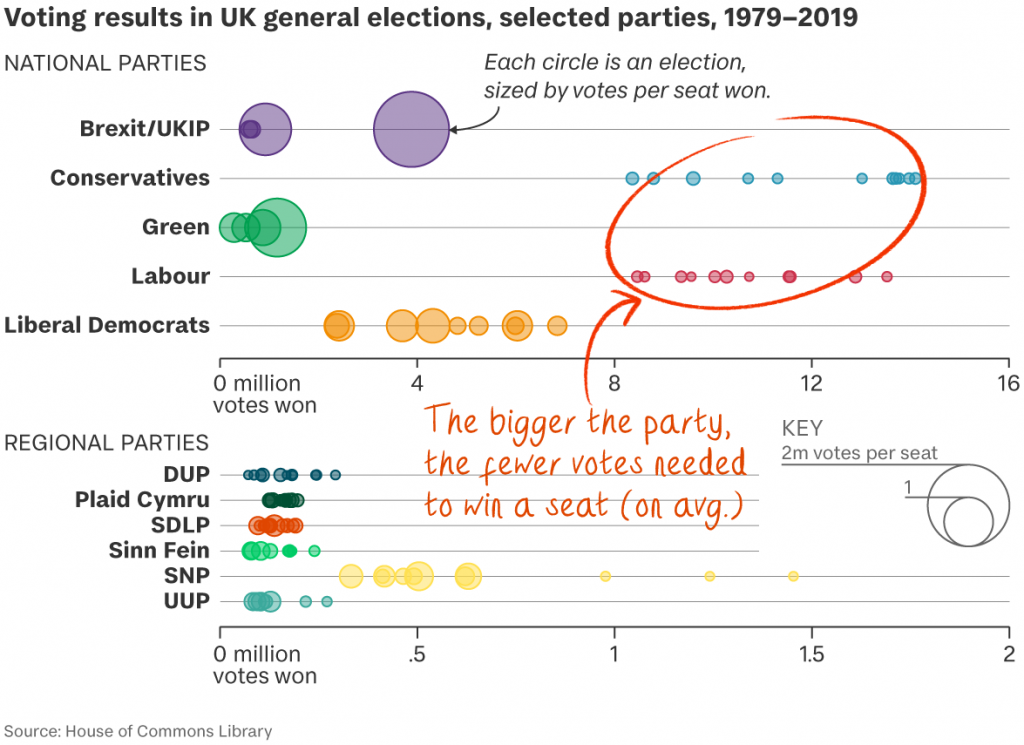
How? Labour’s vote has become more “efficient” than ever by ensuring that instead of gaining more voters in seats it already holds, it wins over just enough people to gain multiple slim majorities in seats around the country.
That should help it secure a parliamentary majority – but will make MPs who win by slim margins extra nervous about the next election (and therefore more likely to speak up on controversial issues even at the cost of party unity).
The numbers speak for themselves:
2,227: swing voters who could have given Corbyn enough seats to bid to form a left-wing coalition in 2017
132,000: swing voters who could deprive Labour of a majority if they change their minds by Thursday
Misery loves company. Given these tight margins, expect to see disaffected voters to the left and the right of Labour from 5 July, and a small but highly motivated group of MPs who are likely to push to reform the electoral system through proportional representation.
Good luck with that. The campaign to adopt PR dates back to 1884. The closest the UK has come to using it is in elections for governments in Scotland, Wales and Northern Ireland, as well as regional mayors in cities such as London, under devolution measures introduced by New Labour.
Winners’ preference. The Conservatives have always been staunch supporters of first past the post, of which they have been the chief beneficiaries.
- The Tories went so far as to scrap London’s PR system ahead of May’s local elections, prompting accusations of attempted gerrymandering. (Labour’s Sadiq Khan won a third term with an increased majority.)
- But it’s not just the Tories: in a 2011 referendum the UK voted 68 per cent to retain first past the post. Some of those who worked on the ‘No to AV’ campaign went on to work for Vote Leave.
- Labour, too, has flirted with electoral reform, but winning parties tend quickly to forget such plans.
The case against. It’s not just self-interest. The argument most often made for first-past-the-post is as a bulwark against the rise of extreme parties on either side.
It’s a system that has helped the centre hold in Britain even as the fringe is poised to take power in France. But at a time of historically low trust in politics, some voters will see it as simply being ignored.
What’s more… The one party that might get a representative share of MPs is the Liberal Democrats – normally the most prominent advocates of electoral reform. If they become a serious political force again, that could mean change at last.