The future looks more uncertain for India’s leader – and his billionaire allies.
Prime Minister Narendra Modi claimed victory yesterday in India’s elections – but with a much narrower win than expected.
So what? Modi will get a rare third term in office, but his Hindu nationalist Bharatiya Janata Party (BJP) will rely on smaller allied parties to form a government. That uncertainty has already had an impact on the families that control much of India’s wealth.
- In India’s last general election in 2019, Modi’s party won 303 seats; this time it was aiming for a lofty 370.
- But the BJP ended up winning 240 seats – not enough to secure a majority in the country’s 543-strong parliament – while the opposition did better than expected.
- It’s the first time since 2014 that the party has been unable to govern alone, piercing the aura of supremacy that Modi has built around himself.
India’s stock markets dropped 6 per cent on Tuesday when it became clear that Modi would not win by the expected landslide, its steepest fall in four years. Companies considered “Modi stocks” did particularly badly.
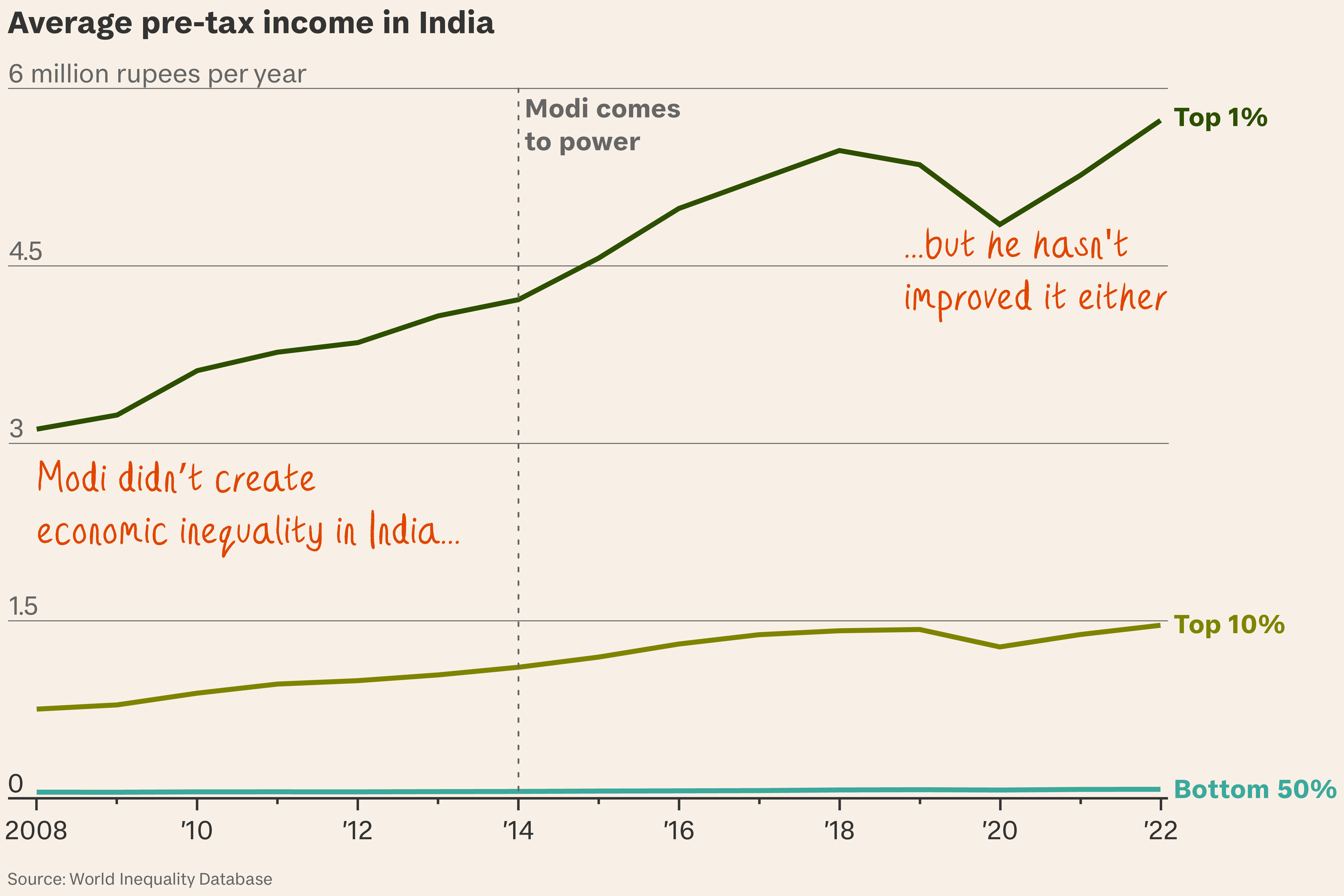
Billionaire Raj. India is now more unequal than during British colonial rule, according to a recent report by economists including Thomas Piketty. The richest 1 per cent earned 23 per cent of national income last year – the highest level recorded since the 1920s – and held more than 40 per cent of the country’s total wealth.
The authors found that inequality had worsened since Modi came to power in 2014, while “the very rich seem to be doing very well”.
The number of ultra-high net-worth people in India – worth $30 million or more – is expected to grow by 50 per cent by 2028, thanks in part to Modi’s pro-business policies including cuts in corporate taxation.
A handful of billionaire tycoons, including Mukesh Ambani, Gautam Adani and Savitri Jindal, are among the world’s richest people.
Mukesh Ambani is chairman and managing director of Reliance Industries and the richest man in India, worth $116 billion. Ambani has seen his wealth multiply five-fold during the Modi years and is said to enjoy close ties to the PM. He is currently paying for several pre-wedding extravaganzas for his son: a three-day event in March attended by Mark Zuckerberg and Ivanka Trump cost an estimated $150 million with a performance from Rihanna, while 800 guests are currently enjoying a Mediterranean cruise around Palermo, Rome and Cannes before the big day in July.
Gautam Adani is India’s second richest person (net worth: $72 billion). When Modi won a thumping majority in 2014 general elections, he flew from the western state of Gujarat (home to Modi, Adani and Ambani), to the capital New Delhi in Adani’s private jet. Since Modi came to power, Adani’s wealth has grown from about $3 billion to at least $90 billion on the back of government tenders to develop India’s port and airport capacity. In 2018, Modi’s government changed the rules to allow companies with no prior experience in the sector to bid for six newly privatised airports: Adani secured them all. Last year his business faced claims of financial fraud from the US short seller Hindenburg Research (it denies wrongdoing); his group’s stocks swooned and recovered but yesterday Adani’s two flagship firms saw up to a fifth of their value wiped out in the day’s biggest loss on the benchmark Nifty 50 index.
Savitri Jindal and her family are worth $35 billion and Jindal, who chairs the Jindal group, is the richest woman in India. She’s an enthusiastic Modi supporter and officially joined the BJP earlier this year; her son Naveen Jindal left the opposition Congress party to join the BJP and run for election in his home state of Haryana. After casting her vote for the BJP, Savitri Jindal said the country has developed at a fast pace under Modi’s government. According to Forbes her family’s net worth fell yesterday by $2.1 billion.
The final results from a six-week election process are not a “total repudiation” of Modi, says Pratap Bhanu Mehta, a senior fellow at the Centre for Policy Research in New Delhi. “But a certain distaste for his hubris seems to have set in.”
What’s more… Pollsters know it even if Modi himself doesn’t yet. One tearful expert who’d forecast an outright BJP win apologised on TV as the results came in.