It’s doomed to violate its own rules year in, year out, and especially now.
On Wednesday, the 20 year-old Ukrainian-Israeli singer Eden Golan was booed and heckled by hundreds of pro-Palestinian protestors during her dress rehearsal for Saturday’s Eurovision Song Contest in Malmö.
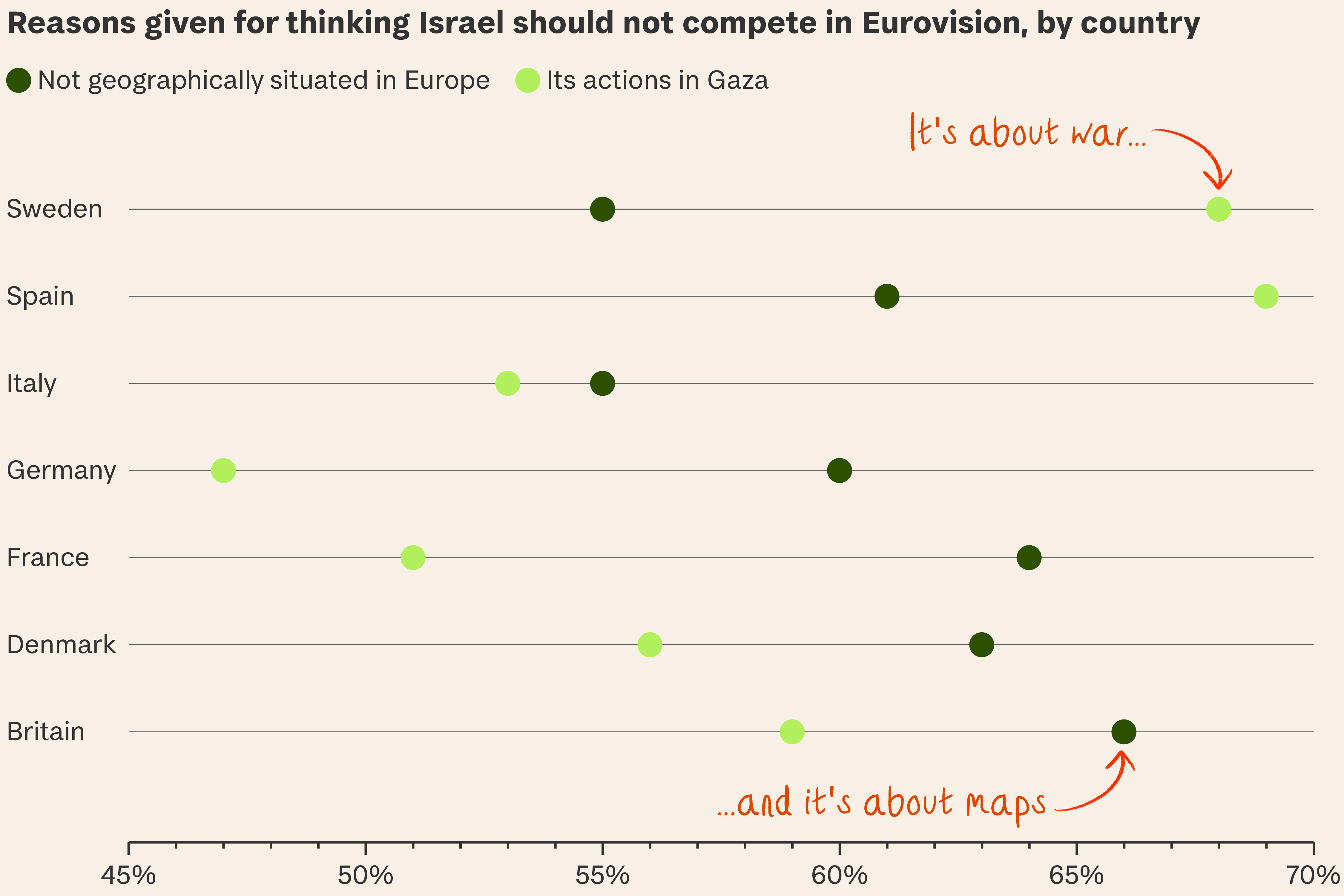
So what? For a contest that tries to appear cheerful, apolitical and frothy, Eurovision has always been divisive, political and bitter. This year, the presence of Israel has outraged protestors and prompted artists from Finland, Iceland and Sweden to sign an open letter, arguing that to ban Russia over its invasion of Ukraine but allow Israel to compete showed “double standards”. For what it’s worth, Russia’s invasion was unprovoked. Still…
- Palestinian-Swedish singer Eric Saade wore a Palestinian keffiyeh around his wrist in Tuesday’s semi-final.
- Irish entry Bambie Thug say they were forced to remove pro-Palestinian writing from their face and leg.
- Australian musician Fred Leone wore body paint resembling a watermelon as an act of Palestinian solidarity.
Politics on the dancefloor. The Eurovision final will be watched by more than 150 million people around the world and 15,000 fans inside Malmö Arena. A pro-Palestinian protest outside, calling for Israel’s removal from the contest, is expecting at least 20,000 attendees. A Quran-burning counter-protest is currently awaiting police approval. Around 20 per cent of Malmö’s population is Muslim. Inside the hall, only national flags from competing nations and the rainbow flag are allowed, effectively banning the Palestinian flag. To prepare…
- Sweden has brought in extra police including officers from Denmark and Norway to oversee security at the final.
- Military snipers on rooftops and surveillance drones will be deployed in case of terror attacks.
- Shin Bet, the Israeli intelligence agency, is in charge of protection for Eden Golan, who has been confined to her hotel room since arriving in Sweden.
Boom Bang-a-bang. It’s 50 years since Abba’s Waterloo won Eurovision, but that isn’t the only song in the contest lamenting military defeat.
1960s Spanish entries were regularly coded protests against General Franco’s fascist regime written by defeated Spanish Civil War troubadours.
In 1975 Turkey invaded Cyprus and Greece boycotted the contest. The following year, the Greek anti-war entry specifically referenced Turkey’s presence on the island. Turkey boycotted the contest.
In 1993 Bosnia and Herzegovina entered the song Sva Bol Svijeta about the siege of Sarajevo. The country’s votes were hard to count as the phone line from the city went down during the broadcast.
In 2009 Georgia’s Put in Disco – chorus: “we don’t wanna put in” – was deemed an unsubtle attack on Putin following the 2008 Russo-Georgian War. Georgia refused to change the song and withdrew.
In 2015 Armenia marked the centenary of the Ottoman’s massacre of Armenians by sending Genealogy, made up of Armenians from five continents, with the song Face the Shadow.
This year Golan’s song Hurricane was originally called October Rain to commemorate the victims of last year’s Hamas attacks, until contest organisers demanded a re-write.
We’re not in Kansas anymore. Queers for Palestine have called on the UK’s contestant, Olly Alexander, to boycott the contest, and they’ve persuaded the venerable London gay pub the Royal Vauxhall Tavern – motto: serving confirmed bachelors and friends since long before Kylie was born – to cancel its traditional Eurovision party.
Down with this sort of thing. Various attempts have been made over the years to depoliticise Eurovision. In 1997, public voting was introduced to balance voting on political lines by official national juries. In 2015, “anti-booing technology” muffled protests over the Crimean invasion during Russia’s performance. Back in 1978, when it became clear that Israel was going to win, Jordanian television cut the broadcast short and announced Belgium as the winner.
Mic drop. “Our sympathy is with all people who say that war is shit,” Ukrainian contestant Alyona Alyona told CNN. “Because who, if not we, can say what is war, and how shit it is?”