Ramadan has started across the Muslim world, including Gaza. Three weeks ago Israel said it would launch a new ground offensive coinciding with the holy month if a comprehensive hostage deal hadn’t been agreed. Ten days ago President Biden said he hoped a ceasefire would be in place by last Monday.
So what? It wasn’t.
- There is no ceasefire.
- A ground offensive could be launched at any time on Rafah in southern Gaza, where more than a million Palestinians are in temporary shelter.
- More than 1,200 deaths in Israel and nearly 31,000 in Gaza in five months of carnage have united all but three UN member states behind calls to suspend the fighting.
- Yet it goes on, and it could escalate even if Israel doesn’t attack Rafah: on Friday a Hamas spokesman called Ramadan “the month of jihad”.
Why no ceasefire? A deal on the table in Cairo last week would have brought a six-week pause and the release of 40 hostages in return for several hundred Palestinians held by Israel. The White House said the onus was on Hamas to accept it. Instead, one stalemate has been substituted for another.
Pretext. Public explanations for the Israel-Hamas impasse have shifted in the past few days:
- Before Cairo, Hamas’s condition for a ceasefire was full Israeli withdrawal from Gaza, which Israel called "delusional".
- Israel’s was for the release of all remaining hostages or at least a full hostage list, which Hamas said it couldn’t produce without a ceasefire.
- At Cairo they deadlocked on the type of ceasefire. Hamas said it should be temporary leading to long-term; Israel stuck to its broader goal of eliminating Hamas.
The upshot is the same: the arrival of Ramadan, with no end to the war.
Subtext. The underlying reality is that key players on both sides have more to lose from a pause than from prolonging the war. “These are people with a vested interest in the conflict continuing despite the suffering and risk of escalation,” says Yossi Mekelberg of Chatham House.
Specifically:
- Benjamin Netanyahu would face the likely end of his long political career if an extended ceasefire gave Israeli voters a chance to pass judgement on the catastrophic security failure of October 7th.
- Yahya Sinwar, the Hamas military leader thought to be still at large in southern Gaza, will have to offer Gazans his own explanation for a death toll now approaching 31,000, and blaming Israel alone may not suffice.
Deus Ex. The only third party that could force Israel’s hand is the US. Instead it rushed weapons to Israel in the immediate aftermath of October 7th and has declined to halt shipments since. Biden has told Netanyahu an assault on Rafah would cross a US red line. He’s also hosted Benny Gantz, Netanyahu’s ministerial rival – but more to admonish the embattled prime minister than to force him to halt military operations. And recent US air-drops, like the plan to deliver aid in bulk via a floating pier, demonstrate a lack of American influence over Israel as much as any prowess in logistics.
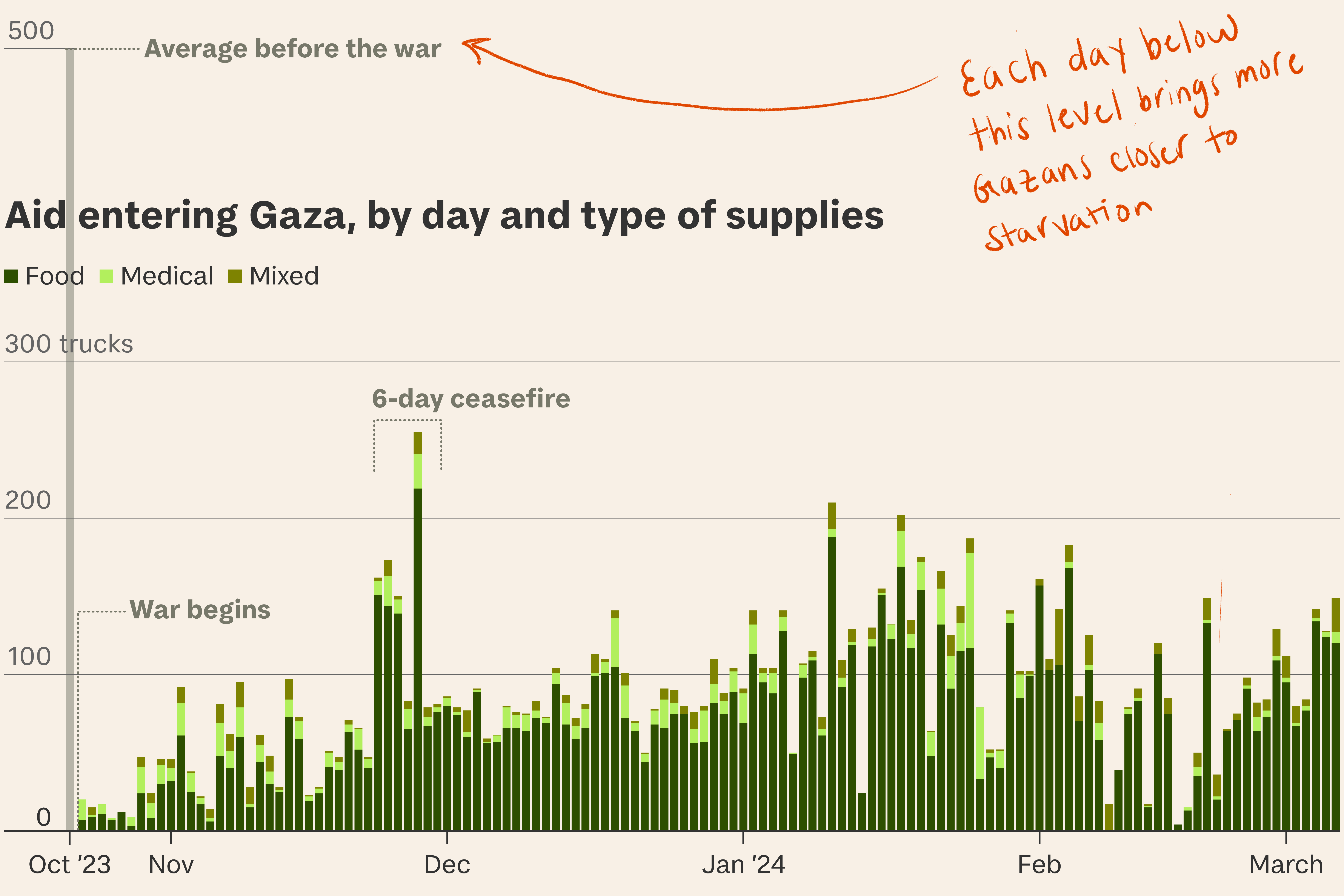
The aid is critically urgent – last week brought the first reports of children dying of starvation in northern Gaza – but there is something wrong when the US is dropping aid off Gaza’s coast while contributing the bombs that make it necessary.
At prayer. Inland, hope is not lost. Netanyahu has chosen not to restrict prayers at Jerusalem’s al-Aqsa mosque, while the Palestinian Authority has so far broadly cooperated with Israeli security forces on the West Bank.
- The risk for Israel in taking draconian measures over Ramadan is of inciting a third intifada.
- The reward for the PA for refusing to be drawn into Hamas’s war is, potentially, control of Gaza, a Hamas fiefdom for the past 17 years.
At stake. Rafah and its surroundings are the last place of relative safety in Gaza for its refugees; the last place not directly controlled by the Israeli army; and the last place – it says – where Hamas fighters and their leaders are still hiding.
Hence the threat of a renewed ground offensive even though it would jeopardise
- a fragile peace in East Jerusalem;
- Israel’s tense relationship with Egypt; and
- any remaining hopes of a normalisation of Israel’s relations with Saudi Arabia.
Sending tanks into Rafah during Ramadan would be an act of folly, Mekelberg says. That doesn’t mean it won’t happen. If it does, expect a new surge of protest, if not worse, from Michigan and Stoke Newington to Pakistan and Bangladesh.