
Ireland has a far-right problem
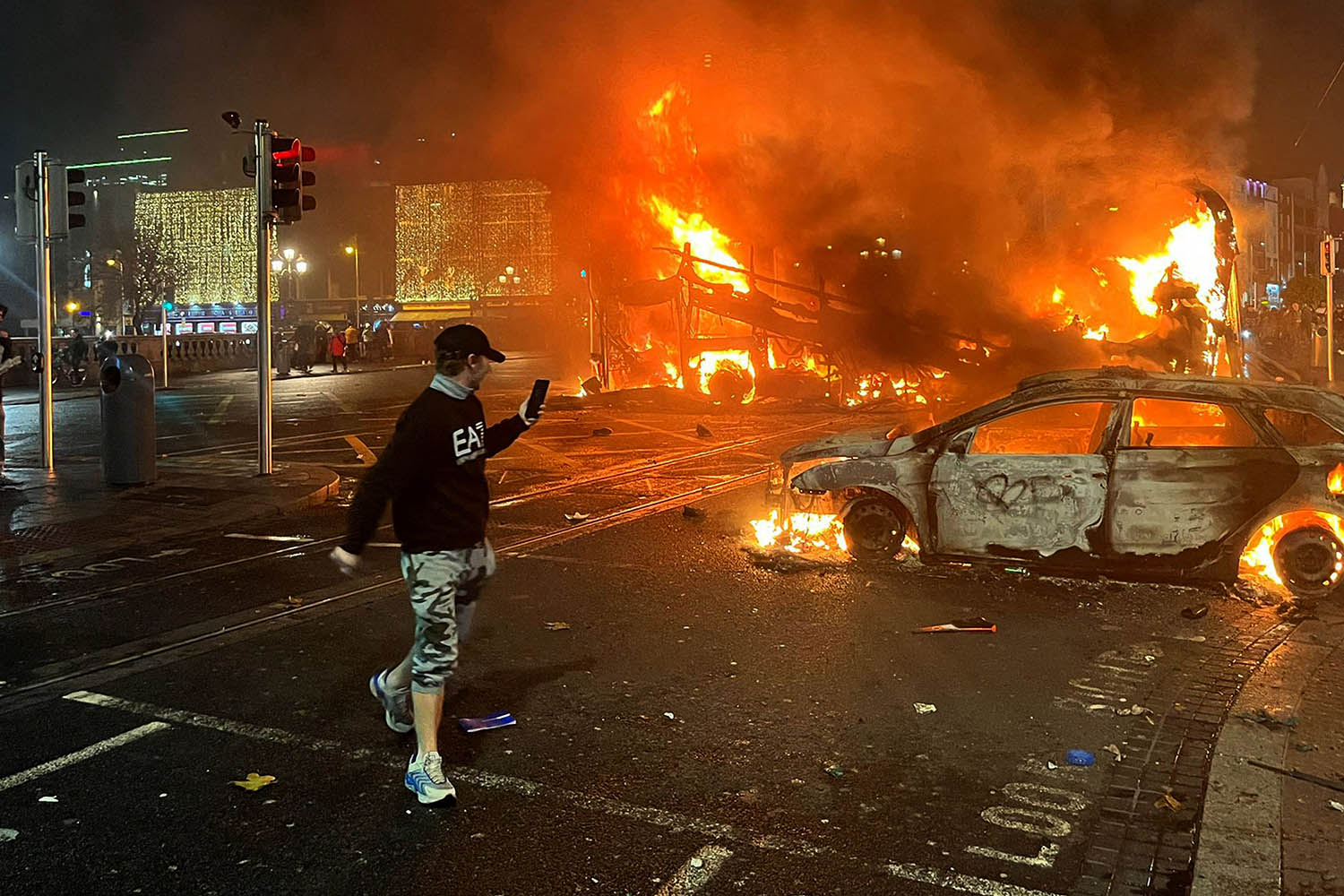
Irish police are expected to make more arrests in the coming weeks after riots erupted in Dublin City centre last Thursday. The violence that set Dublin alight was sparked after a woman and three young children were stabbed outside a primary school in the city centre; rumours quickly spread among right-wing groups that the perpetrator was an Algerian migrant.
Police officers were injured, shops were looted, buses were set alight and 48 people were arrested – videos posted on social media paint a picture of abject chaos. Drew Harris, Ireland’s police commissioner, blamed “a complete lunatic faction driven by far-right ideology” and said he expected to see further such protests. The commissioner said they “could not have anticipated that this would have been the reaction.” But Ireland’s far-right problem has been hiding in plain sight for some time.
The unrest comes two months after a far-right protest outside Ireland’s parliament, which featured mock gallows pasted with MPs’ faces.
Last week, the Institute for Strategic Dialogue (ISD) found that the mis- and disinformation ecosystem in Ireland was co-opted by far-right actors who, after the pandemic eased, turned their attention towards other matters, such as that of asylum seekers.
The ISD said social media companies’ failure to curb the spread of false and harmful content has emboldened and boosted the reach and influence of the far-right — the worst platform, the study suggests, is Elon Musk’s X.
After the stabbing, it didn’t take long for speculation over the perpetrator’s nationality to begin proliferating online. MMA fighter Conor McGregor — the “say-it-like-it-is” embodiment of the “fighting Irish” — galvanised rioters by tweeting about the “grave danger” posed by those “that should never be here in the first place”.
But it wasn’t just those on the right on the streets on Thursday. Rory Hearne, an associate professor in social policy at Maynooth University, said those who are “disenfranchised and socially excluded” also attended. Ireland is suffering a housing crisis, and the far-right is using this, Hearne says, to ostracise asylum seekers and refugees.
The riots were condemned by Ireland’s main political parties. There is no large far-right party in Ireland in a way that’s comparable to other European countries – rather, the far-right in Ireland is led by figureheads on social media.
The attacker’s identity has not been revealed. But we do know the identity of the man who intervened and stopped the attack.
Caio Benicio, a Deliveroo driver from Brazil, hit the attacker with his helmet after witnessing the stabbing. Over the weekend, a fundraiser called “Buy Caio Benicio a pint” raised over €350,000.
Speaking of the riots, he said: “It looks like they hate immigrants. Well I am an immigrant, and I did what I could to try and save that little girl.”