Sensemaker Daily
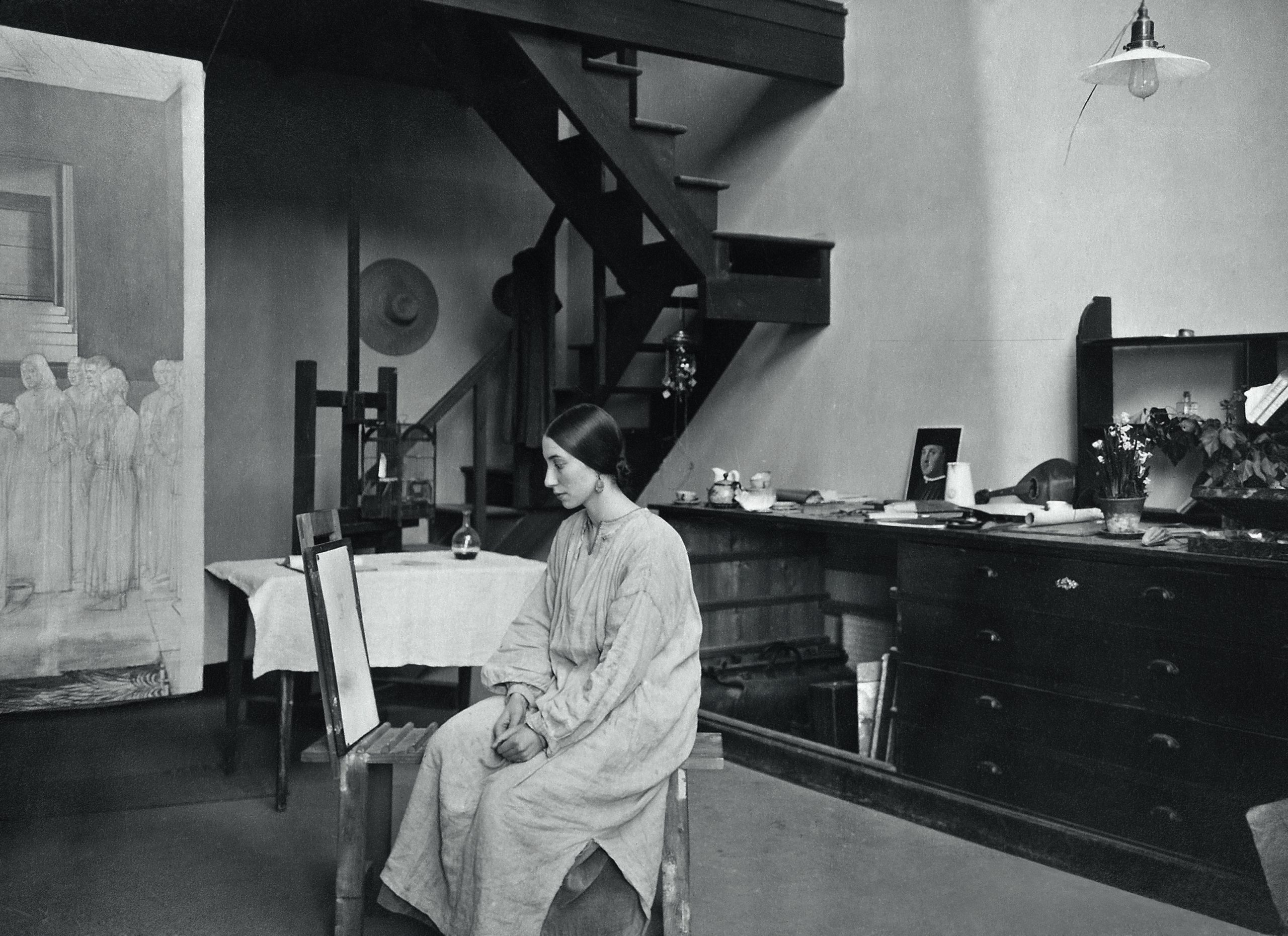
Rosie Blunt on how Winifred Knights was unjustly painted out of the picture
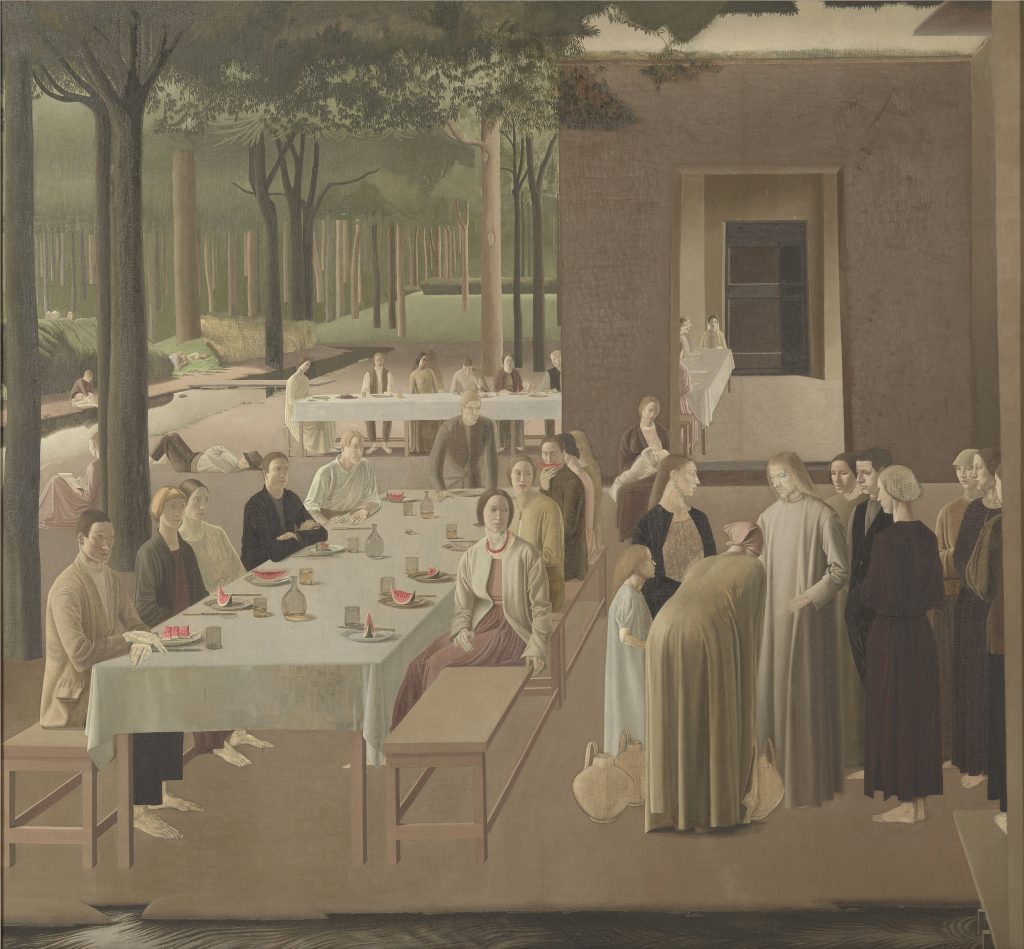
The Marriage at Cana is 100 years old this year. The painting – a portrayal of the feast where Jesus turned water to wine – is a brooding reflection on religion’s waning influence on society and the suffocating restrictions of marriage.
The artist chose to focus on the guests at the wedding, who eat their watermelon and look on passively as Christ performs the miracle. The key moment of transformation is in fact blocked by a woman’s back and Christ – halo-less and dressed in a drab smock – could well be mistaken for just another guest. The effect is to subvert that pivotal Biblical moment into one of frustration and impatience.
A study of The Marriage at Cana was on display at Rome, a Portrait, a festival held from May to July 2023 that celebrated the city’s international art links. But the artist, once feted like a modern celebrity and part of what we might now call a power media couple, is all but forgotten.
Winifred Knights painted The Marriage at Cana, her masterpiece, while living in Rome as the first female recipient of a highly prestigious scholarship – the Prix de Rome – to study decorative painting at the British School. She had earned her place with another painting, The Deluge, an apocalyptic depiction of the Bible’s Great Flood that radicalised traditional views of Noah’s Ark. The Daily Graphic hailed that painting as “the work of a genius” in a review in 1921.
The Marriage at Cana was exhibited across the world and with The Deluge and two other major paintings, Edge of Abruzzi and The Santissima Trinita, garnered great critical acclaim. But in the years preceding her death from a brain tumour at the age of 48 in 1947, Knights’ career fizzled out. The art world lost interest. No obituaries of her were published.
“People often make the mistake [of thinking] that forgotten women artists were forgotten because they were unprofessional and just painted in their spare time, but many were incredibly successful in their own day. It’s just that they were never written into the history books,” says Sacha Llewellyn, who has written a book on Knights and set up the organisation Rediscovering Art by Women.
In addition, many women weren’t allowed to be part of artist movements that were “incredibly misogynistic”, Llewellyn explains.
In the Dictionary of National Biography, Knights was only ever referred to as “Sir Thomas Monnington’s First Wife”. An artist remembered in relation to her husband is not unusual. As Katy Hessel, of The Guardian, discovered on a visit to the National Gallery, “of the shockingly low six works on view by women in the entire museum, two mention male artists in their 50-word labels”.
But in 1923 Knights’ self-portrait appeared on each of the three tables depicted in The Marriage of Cana – a nod to the widening recognition she was receiving in Rome as the work neared completion. Arnold Mason, the artist Knights was engaged to when she started the composition, sits on the front table with arms moodily crossed, an empty glass in front of him.
On the back table, seated next to the artist, is another Rome scholar, Tom Monnington. Gazing awkwardly downward at the full glasses of wine in front of them, the growing fondness between the couple is clear.
Both artists had studied at the Slade School of Fine Art and were protégés of the infamous Henry Tonks, a sarcastic surgeon-turned-artist renowned for his painfully faithful pastel drawings of soldiers whose faces had been mutilated by war.
Knights won the Prix de Rome in 1920 and Monnington followed in her footsteps the next year. It was here that the couple forged a romantic connection and where they married in 1924.
Although she adored Monnington, Knights was always sceptical about marriage. After breaking things off with Mason, she called engagement “a beastly word”. It was a view perhaps shaped by her parents, who were fiercely ambitious for Knights and did not initially support her engagement to Monnington, fearing that it would affect her career. Her teacher, Tonks, encouraged his female students to remain single, claiming that “their work always deteriorates when they get married”.
In the 1920s, marriage did indeed usually signify the end of a woman’s working life. Married women were not allowed to work as teachers – art included – until 1944.
But Monnington and Knights’ marriage seemed for a while to be an exception to this trend. In the years following their engagement, they worked productively and were widely celebrated in society.
And Monnington was far from an overbearing husband, his masculinity unscathed by his wife’s success. After their wedding, he wrote to his brother: “I am extraordinarily happy, but then I have an extraordinary wife.” Knights’ influence on Monnington’s own work was so profound that friends started referring to him as “Mr Knights”.
His painting, Allegory, still on display at the Tate, illustrates this blissful time of his life amid the Umbrian countryside where the couple sought relief from hot Roman summers. The naked Adam and Eve figures are a celebration of their union. Like The Marriage of Cana, in which the pencil sketches of the guests’ feet poke out from under the table, Allegory remains unfinished, fading out into mere outlines to the left of the frame. Critics claim this was intentional, part of the modernist aesthetic.
But Knights’ practice of leaving her work unfinished has always been attributed to her self-criticism and painstakingly meticulous planning, which was influenced by Tonks, a notorious perfectionist.
She was a brutal self-critic and said of The Marriage at Cana that it was “a wretched failure” which she was “very depressed about”.
This imposter syndrome was no doubt reinforced by the art world’s entrenched bullying and misogyny. On the couple’s return from Rome, Knights was excluded from a prestigious scheme inviting top artists of the day to decorate public buildings. Monnington, meanwhile, was included and commissioned to produce a mural for St Stephen’s Hall in Westminster.
“Tom is the wonder child now,” she wrote to a friend. “He is getting to be a very famous young man.” The friend noted that she sounded “a little jealous”, and no wonder, when the man in charge of the scheme – David Young Cameron – had said Knights was “best of all” of the British School of Rome’s scholars of the past few years, Monnington included. Yet still she was excluded.
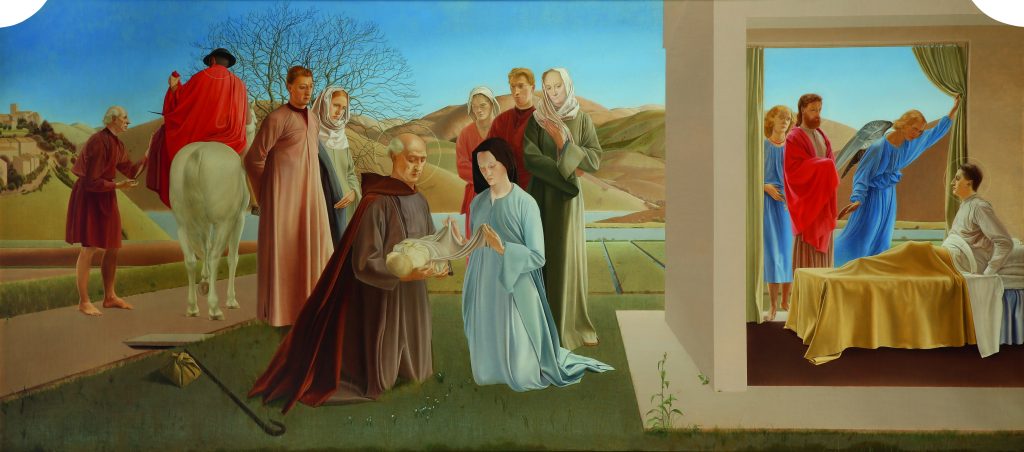
At the turn of the decade, Knights was commissioned to paint a mural for a restored chapel in Canterbury Cathedral: a painting that became known as Scenes from the Life of Saint Martin of Tours. She garnered faithful support from the Dean at the time and her design progressed into a beautifully unique piece with a “lucid palette, mimetic clarity and elongated, flattened figures”, according to Sacha Llewellyn. It was quintessential Knights.
A year into painting, the Dean departed and was replaced by another who showed no interest in having a painting in the chapel. The architect who had restored the chapel, Sir Herbert Baker, stepped in and suffocated Knights’ design. His domineering instructions “removed the essentially modernist elements that had thus far characterised her designs”, wrote Llewellyn. Eventually he moved it to the Lady Chapel in the crypt, probably shattering Knights’ confidence in the process. The final painting – with round faces and primary colours – seems devoid of the striking, muted angles of her previous works.
The Monningtons’ son John was born in 1934, and from that moment Knights stopped painting, instead pouring all her passion and energy into nourishing him. Seven years earlier she had given birth to a stillborn baby, a trauma that prompted an obsessive attachment to John.
“I never, ever left her side,” John, a former engineer, remembers. “She was stuck to me like an amoeba, which was ultimately rather an encumbrance.”
Still, he remembers his parents as “ a golden pair, always in the papers… They had friends of great wealth. It was a time of remarkable affluence.”
John remembers the “overwhelming influence and command” his mother had on those around her, earning them attention and access wherever they went. “Even on the train, I was allowed to visit the engine driver,” he says. “She had a celebrity status.”
When the Second World War came, Knights’ paranoia intensified. The First World War had left Britain’s female population deeply shaken, their suffering and grief overshadowed by the immediate trauma of the men on the frontlines. Knights was no exception. Having suffered bombing near her home in south London, Knights wrote in 1918: “I can’t let an aeroplane pass over my head without feeling terribly ill and shaky.” The year before, a munitions factory in what is now Newham, east London, had exploded, killing 73 people. Knights witnessed the blast from a tram crossing Blackfriars Bridge. Her distress was such that she retreated to a relative’s farm in Worcestershire for the remainder of the war.
Two decades later, as she felt another war veer closer to her home in the East Sussex countryside, Knights picked up five-year-old John and fled. She feared their beautiful house – set amid orchids with a walled garden – was vulnerable to bombing, so instead sought the comfort of friends in far-flung corners of Britain, from Wales to the Cotswolds, to Shropshire and to Scotland.
John has a patchwork of dreamlike memories stitched together from his nomadic early childhood spent hauling suitcases from train to train. He remembers the travelling players who performed Shakespeare plays in the gardens of a friend’s home at Chipping Campden. He remembers sailing the Norfolk Broads with family friends and, bizarrely, their two ring-tailed lemurs joining them on board. He remembers a shipwreck off the coast of Anglesey. Much to the excitement of hungry residents surviving on rations, the boat was carrying oranges, which floated up to shore. John rushed to the sea and grabbed an orange, but as he bit into it, his mouth filled with salt.
John’s appearance matched their chaotic lifestyle. “She allowed me to grow my hair very long,” he says. “I wasn’t allowed to wear garters so my trousers slipped down. She bought me an overcoat that was four sizes too big.”
Knights showed no interest in John’s formal education. Eventually, aged about eight, authorities in Fife tracked him down, forcing him to attend school for the first time.
Tom Monnington, meanwhile, was assigned war duties that forced distance from his family – at first distributing gas masks then later working as a camouflage artist. In 1943, he made use of the flying lessons he had taken before the war and produced paintings of aerial warfare that helped solidify his place as a prominent artist. John believes his father “rather enjoyed the war”.
But his parents’ marriage suffered greatly. By the end they had separated and Knights’ mental health seemed to have taken a turn for the worse, no doubt due to the brain tumour that eventually killed her. After her death, John and his father found jars upon jars of vitamins in her home, presumably used to try to anaesthetise her headaches.
John learnt of his mother’s death while he was at school in a formal meeting with the headmaster, whom he thanked for the news before returning to lessons. He was 12.
The last time he’d seen his mother was at a friend’s flat.
“The light was shining behind her so that she was somewhat of an unreal personage who I waved goodbye to,” he says.
Tom Monnington’s celebrity status endured throughout the 20th Century – he became president of the Royal Academy of Arts in 1966 and was knighted the following year. Soon after Knights’ death, he remarried another artist – my grandmother’s sister, Evelyn (née Hunt). When my mother visited her widowed aunt in that same house Knights had fled from decades before, she noticed a wistful portrait that hung faithfully above Evelyn’s bed. It was Knights, sketched by the man both women had married. The Royal Academy took down The Marriage at Cana even before Knights had died. After being rejected by other galleries because of its size, the painting spent many humiliating years stored under a stairwell in the British School’s London office. In 1958, it was eventually gifted to the National Art Gallery of New Zealand, now known by its Māori name of Te Papa. After years of abandonment, the painting is frequently exhibited there. It is described as one of the museum’s treasures.
Rosie Blunt is a journalist at BBC South East
This piece originally appeared in Faith, the 13th edition of Tortoise Quarterly. Faith, and all other editions, are available in to order in glorious, old-fashioned print, at a special members’ discount.