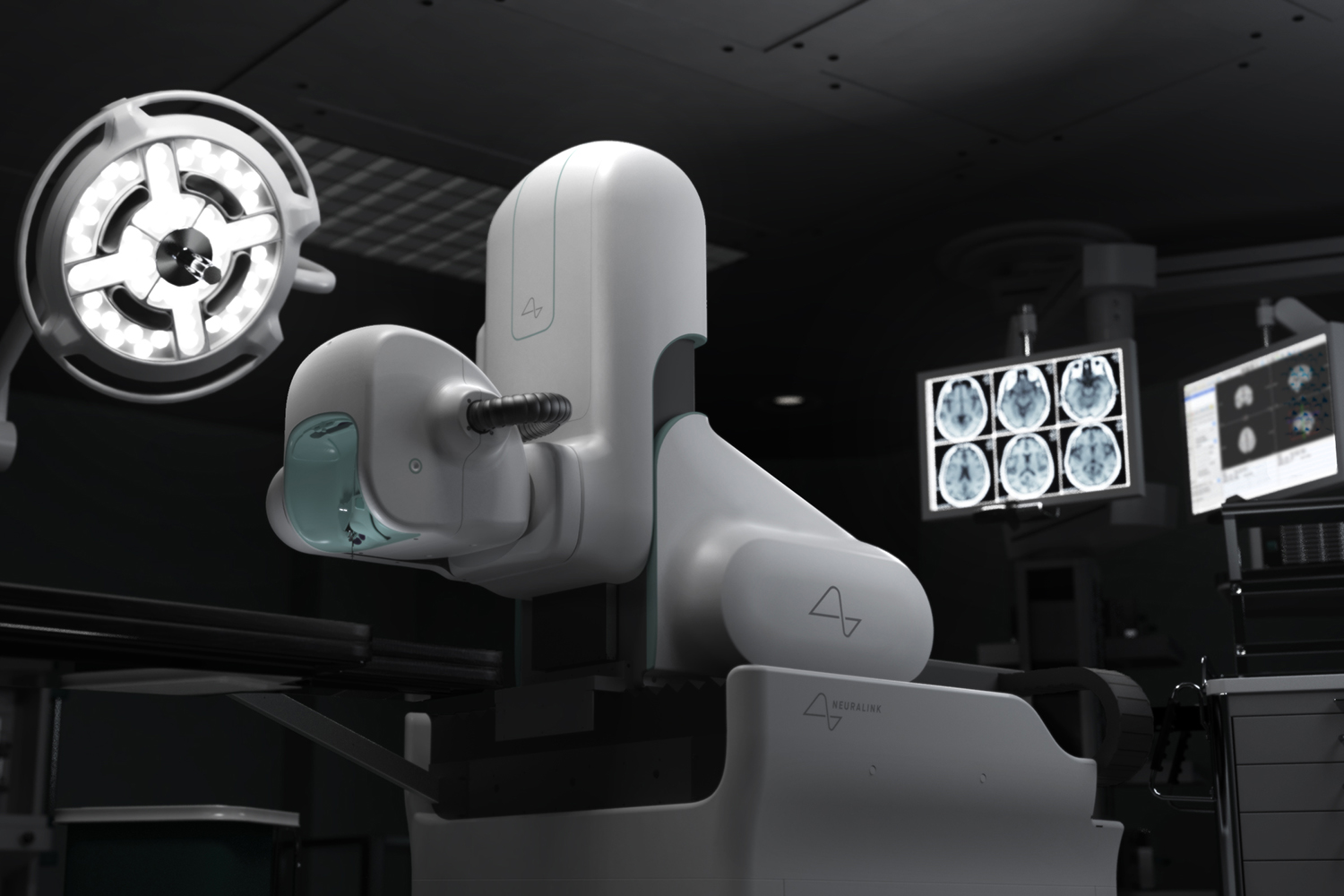
Neuralink is looking for people with ALS – a fatal motor neurone condition – to have a wireless implant inserted into their brain by a robot
Elon Musk’s neurotechnology startup is recruiting people for its first human trials. Neuralink is seeking participants aged over 22 who have quadriplegia or ALS, a fatal motor neurone disease, to have a wireless implant inserted in their brains by a surgical robot.
So what? Neuralink is one of several companies experimenting with brain implant technologies. Most have medical applications, such as helping people with quadriplegia regain mobility. But Musk has plans to take the tech much further – including being able to save and replay memories.
He told a conference in 2020: “The future is going to be weird.”
The technology. Brain-computer interfaces (BCI) have existed since the 1970s, but they are becoming more ambitious.
- The term describes any technology that enables direct communication between the brain and an external device – cochlear and retinal implants are common examples.
- BCIs are currently being used to treat everything from Parkinson’s disease to depression.
- Private investment in neurotechnology increased 22-fold between 2010 and 2020 and the market is projected to reach $24.2 billion by 2027.
- Recent billionaire-backed startups include Neuralink; Bill Gates and Jeff Bezos-backed Synchron; and Peter Thiel’s Blackrock Neurotech.
All three companies are developing neuroprosthetics – BCIs that work with the nervous system to restore motor functions. Tom Oxley, Synchron’s founder and CEO, says it’s going to be a profitable market since 100 million people worldwide have upper limb impairment.
The potential. In 2014, Ian Burkhart was one of the first people in the world to have a Blackrock Neurotech BCI inserted after an accident left him paralysed from the waist down when was 19. The device, which was surgically implanted on the surface of his motor cortex – the part of the brain responsible for motor movements – allowed him to regain mobility in his hand.
“It wasn’t perfect,” Burkhart told Tortoise, “but it was to the point where I could open and close my hand, pick up objects… and that was something that was really powerful to me.”
Neuralink is a latecomer to this field, says L Syd M Johnson of SUNY Upstate Medical University. But its device appears more complex – a trial brochure describes an implant that “records neural activity through 1,024 electrodes distributed across 64 threads, each thinner than a human hair”.
The controversy. Neuralink secured FDA approval for human trials in May, despite the fact that it’s under federal investigation for animal welfare violations.
- At least 1,500 animals have died at Neuralink since 2018, and Musk reportedly pressured staff to rush experiments.
- In a tweet, Musk said “No monkey has died as a result of a Neuralink implant… we chose terminal moneys (close to death already) [sic]”. A recent Wired investigation reviewed veterinary records that suggest otherwise.
“I don’t know why the FDA approved it,” says Johnson. “You’re allowed to kill animals for research. You’re not actually allowed to kill humans in research. And if we mess up on a human, there could be really serious consequences.”
The data collected directly from the brain could be used in everything from medical research to advertising. The big question is what might Neuralink do with it?
“How will they record it and store it? How will they protect user privacy there? Would they, for example, turn that data over to law enforcement if they were asked for it?” says Johnson.
Neuralink did not respond to a request for comment. But these questions go bigger than one company – the UN held a conference in July on the ethics of neurotechnology, calling for a framework to protect human rights in light of BCIs.
Final thought. Burkhart had his BCI removed in 2021 after seven years of trials, catalysed by a developing infection around his brain. He hopes the Neuralink trial will raise awareness – and funding – for the technology. “It’s a little bit of a rising tide that lifts all boats,” he says.
In the right hands, brain implants could change lives for the better. But yet again – along with the electric car transition, social media, satellite communications and humanity’s survival on Mars – those hands belong to Musk.