
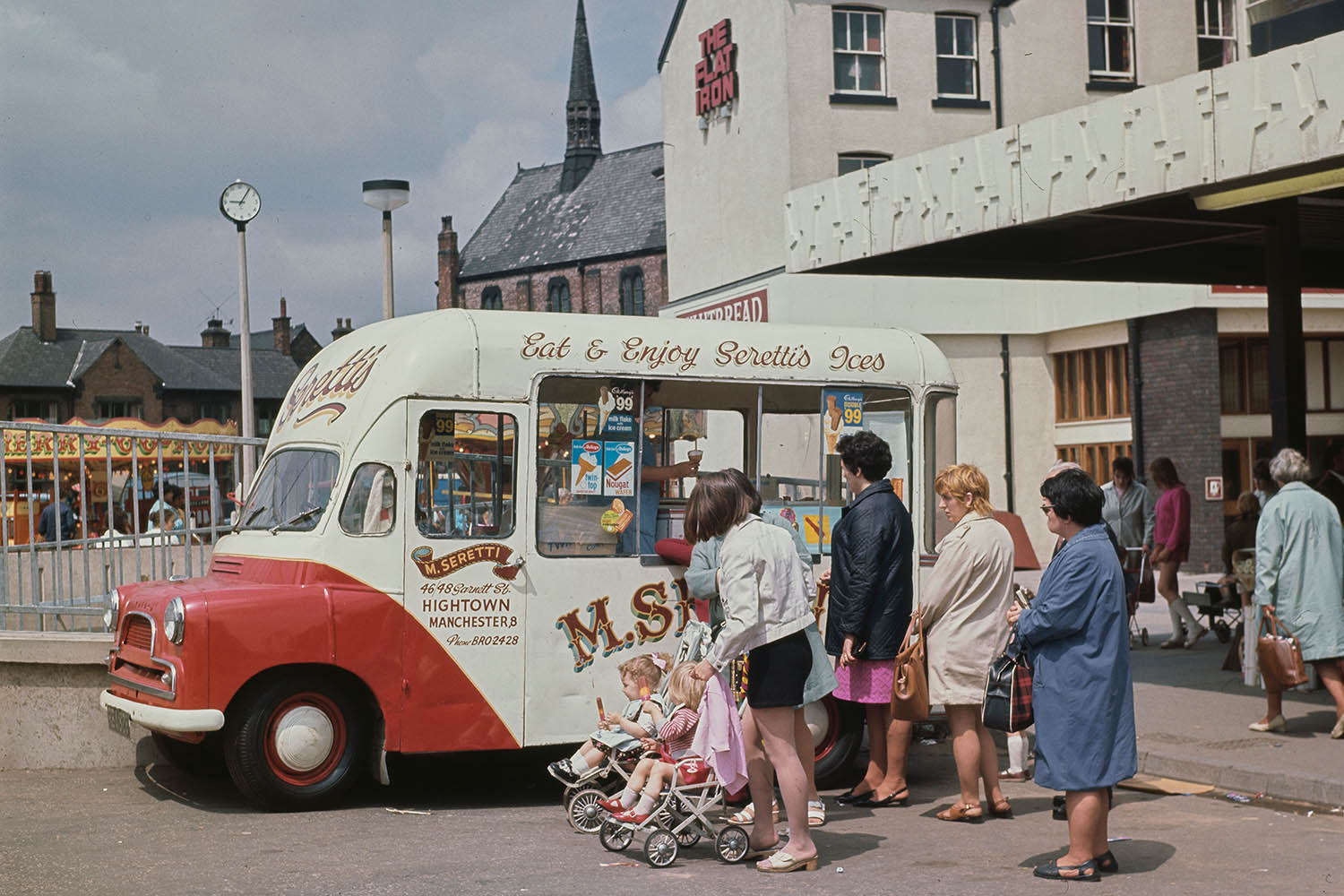
<em>Hattie Garlick</em> tells the story of the vehicle’s surprising 100-year history
For a vehicle whose sole objective is to attract attention, it is surprisingly hard to track the very first. Here’s what we know. Wall’s opened its first ice cream factory in Acton, west London, in 1922. In the subtle alchemy of freezing milk, cream and sugar, it found the perfect formula with which to mesmerise children. But how to get the magic to the masses?
By 1923, ice cream trikes were beginning to appear on British streets, in children’s imaginations and before long within the deepest recesses of our national nostalgia. That year children learnt to play with one ear cocked for the tantalising tones of the Wallsie bell. And we have never stopped. Pedals gave way to motors, bells to chimes. Trikes morphed into ice cream vans and for 100 years their drivers have played pied piper to British children. We all grew up waiting for him. But from his unique position on every scruffy street corner, from behind his sliding screen, the ice cream van man has watched us change too.
“Under a pile of rubble in a barn in Llandudno, in need of a clean and some love, was an original Wall’s blue-painted trike,” says Dave Morris, co-founder of What’s the Scoop, a Surrey company that serves ice creams at weddings and events from a fleet of vintage vehicles. He’s recalling his oldest find: “It dated back to 1926. It has a large metal bell, ‘Stop me and buy one’ painted on its side, and the names of the east London streets it used to visit marked on it.”
Its charm has limitations, though. “It’s a great big heavy wooden box, about 2ft wide and 4ft deep,” says Morris. “Originally, they’d have lined it in cloth, then packed it with ice blocks to keep the ice cream frozen. All that’s supported by a tall trike, constructed from pretty heavy metal. I do bodybuilding and I tell you, it was a struggle to pedal on an upward slope.”
But in the 1920s, before home freezers became commonplace, scooping ice cream from this travelling box was, to children, like pulling a rabbit from a magician’s hat. For the adult guardians of the purse strings, cornets were key to the trikes’ success. Ice cream trikes, Morris explains, were fitted with a basket in which to store these (and a pouch from which to distribute broken pieces to children, for free). Cones replaced the endlessly recycled (and infrequently washed) glasses in which “penny licks” had been served, spread tuberculosis, cholera and parental anxiety till they were banned in 1899.
Affordable, hygienic and with the vital extra ingredient of theatre (Would he come? And would you miss him, in your dash to the kitchen for begged change?), by 1939 the Wall’s fleet alone numbered 8,500. Across the UK you could place a card in your window, requesting a stop. But on 3 September that year, the fun melted abruptly.
Ice cream manufacturing was soon banned under wartime rationing. Trikes were dismembered for metal. Some, however, underwent a rather more eccentric, and somehow archetypally British transformation. “The buildings of Lancing College were requisitioned by the Navy for training,” says Lesley Eastabrook, archivist at the West Sussex public school and unexpected guardian of this chapter in ice cream history.
“The upper playing field was converted into a mini-English Channel, laid out with buoys, lighthouses and significant features of the coastline,” writes a recruit called Anthony Hill in an account Eastabrook safeguards. “This was to enable us to practise the art of navigation. To further aid this purpose, the Admiralty had acquired a number of Wall’s Ice Cream famous pre-war tricycles which displayed the slogan ‘Stop me and buy one’.”
They were painted battleship grey, fitted with a compass, and their freezer boxes transformed into chart desks. “We mounted our little craft and followed our navigation instructor’s orders for changes of course, taking the necessary bearings and plotting these on the chart,” writes Hill, “… calculating deviations for wind and tide… Later on… the instructor would throw a bucket of water over us, to represent the waves over the bridge. This wasn’t far off the real thing for those of us who served in little ships.”
When their wartime duties ended, most trikes were honourably discharged from British streets too. Diesel replaced manpower. And the noise of the bicycle bell gave way to another, one that still serves as an auditory madeleine for all those who grew up between the ’50s and the ’80s: “Greensleeves”.
“The ’60s were probably the real heyday. Back then, you’d have four or five different ice cream vans coming round the streets every day. They’d all be busy, and they’d all take money. It weren’t a fortune, and their parents would use it to keep them in line: you won’t get your ice cream tonight if you don’t clean up.”
John Bonar stretches his legs beneath his desk in South Ockendon. Just north of the Thames Estuary, abutting the M25, this post-war sprawl of a town is where he built his empire, Piccadilly Whip: a fleet of trailers, kiosks, vintage and modern ice cream vans that he owns, operates and sends out across the country.