Sensemaker Daily

How Liz Moseley left the church – and found chaotic, lonely, beautiful freedom
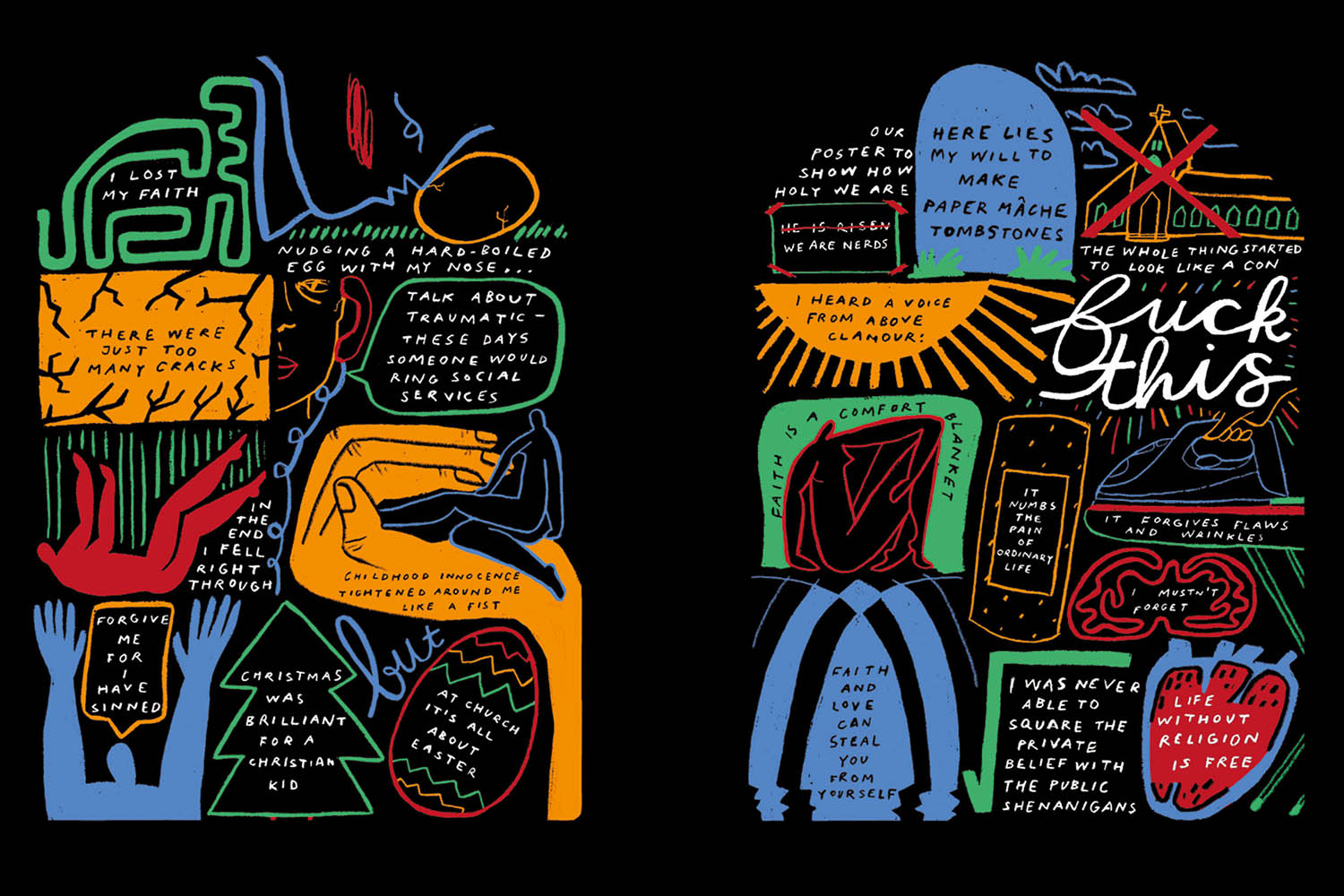
I lost my faith nudging a hard-boiled egg with my nose around the perimeter of St Mary’s parish church, Burley in Wharfedale. It wasn’t what anyone wanted but there were just too many cracks and, in the end, I fell right through them.
I didn’t mind going to church to begin with. Before the under-age drinking years, hanging out in graveyards was way more fun than hanging out in a playground. They’re the perfect arena for hide-and-seek and ideal for a Star Wars rebel alliance stronghold. Sundays were much longer in the 1980s, at least 40 hours each, and there were worse ways to hurry things along than colouring a picture of the Good Samaritan and singing a song about how happy everyone is. Plus, I really liked Mrs Birch, the Sunday school teacher. She wore shiny nylon paisley dresses and sturdy shoes and served us cups of weak squash with a loving earnestness that made me feel safe and special.
Christmas especially was brilliant for a Christian kid in the 80s. The exquisite torture of the advent calendar countdown, the yellow street-light glow on the snowy pavements as we walked back to school in the dark for the carol service. Looking up at the soles of my dad’s slippers on the ladder and the smell of the cold loft air as he passed down damp boxes packed with glittering treasures. I’d rummage for my favourite baubles – the golden pear and apple – and feel genuine relief when every thread was as gorgeous as last year. Mum would say “This year’s Christmas tree is our best ever” and we’d all agree.
I enjoyed making a Christmas book with elaborate, fabric collage pictures of Mary, the three kings and the shepherds. I would really go to town on the glitter. Even though I never got to be the Angel Gabriel in the Nativity play because I was a swot so was made to be the narrator, I loved the carols and the lights, the paper snowflakes and crêpe paper chains looping across the classroom ceiling.
On Christmas Eve we always went to my dad’s parents for tea, where I’d be served Coca-Cola in a petrol station wine glass and eat Wotsits from a cut-glass bowl. On Christmas morning we were allowed to choose one present to take to church and the vicar would talk about how Baby Jesus was the greatest gift. It was a splendid, festive song and dance and I knew every note and all the steps. Joining in made me feel twinkly and real.
My mum was a vicar’s daughter. Her dad, my Grandpa Levesley, was big and jolly, a rugby union superfan, talented gardener and painter, lifelong liberal and prodigious rule-breaker. He was incredibly dangerous behind the wheel of his clapped out Vauxhall Astra. Once he made a sudden right turn across three lanes of oncoming traffic to swing into a parking space outside the school uniform shop, shouting over the honking of horns the now iconic (in our family) explanatory phrase: “It’s OK. They know me here.”
As a fireman in Bradford during the blitz, he’d seen terrible things and turned to God because of it. He was always fun and never pious. My guess is that his faith was deep but not unquestioning but he died before I had the chance to ask him. The gospel according to Grandpa included a couple of key commandments: Sunday best is silly because Jesus doesn’t care what people wear, and “If you can’t say it in less than ten minutes, it’s not worth saying”. He’d frequently describe his fellow clergymen’s sermons as boring and sanctimonious. Amen to that.
When my parents went out for the night I’d get to sleep on a zedbed in Grandpa’s study, squishing the bubbly bits on the Artex wallpaper and examining his noticeboard. There was a hand-painted watercolour of the Sheffield Tigers rugby mascot, a picture of praying hands with “All Will Be Well” underneath and, most memorably, a photo of a bare-breasted woman walking along a sand dune from the Pirelli calendar. Grandpa contained multitudes.
One year – I must have been about six – we had to go to a different, bigger church for a special Pentecostal service where Grandpa had been asked to read a lesson. We were allowed to sit in the choir stalls where everyone could see us. Unlike St Mary’s, this was a modern church that had swapped the traditional organ and Virgin Mary statues for acoustic guitars and a felted banner with a dove on it. The order of service included what was ominously billed as a “dance interlude”.
Some husbands strummed chords as 20 members of the local Mothers’ Union emerged from the vestry. Like a geriatric Tales from the Unexpected, wearing home-sewn, treacherously ill-fitting red and orange tunics to represent the flames of the Holy Spirit, they swished and twirled betwixt the pews and around the font, wafting us urgently with chiffon scarves. It was quite the spectacle. Transfixed and somewhat bemused, I became aware of the choir stall shaking beneath me as a 70-something, 18-stone man in a long, black cassock and dog collar prayed for mercy, battling to stifle his guffaws. Keen to do the good and Christian thing, I followed Grandpa’s cue – he was the vicar after all – and joined in the giggling. This was a mistake. Mum shot me a look that said God does not find this funny and I felt my cheeks burn with shame.
To non-Christians, Christmas is the big one but at church it’s all about Easter. Apart from a bit of egg-blowing, Easter was a non-event at my Church of England primary school. At home, though, there were strict rituals that had to be followed and zero magic. It started off OK. Everyone likes Shrove Tuesday because of pancakes and on Ash Wednesday me and my brother got to set fire to last year’s Palm Sunday bamboo crosses in the lid of a biscuit tin. Blessed be the pyromaniacs. Then we had to get through Lent, six weeks with no sweets and irritable, suddenly teetotal parents, before enduring seven days of public ritual humiliation in Holy Week before we got so much as a sniff of a Cadbury’s Creme Egg.
The appearance of a cardboard charity collection box on our mantelpiece signalled the commencement of abstinence for Lent. It had a cut-out figure of a young man in ecclesiastical robes sitting on it. My dad called him “the constipated curate” because it looked like he was sitting on a commode. Forgive me for I have sinned, because I resented that box so much that once I shook 20p out of it so I could buy a cider lolly from the ice-cream van.
On Palm Sunday, a week before Easter, we would return from church with new bamboo crosses and a poster to put up in our downstairs window just in case the neighbours had forgotten how holy we were. The poster had an illustration of a crucified Jesus on a maroon background with “THIS IS HOLY WEEK” underneath. On Easter Sunday, you had to fold down a flap, which revealed the words “HE IS RISEN”. It may as well have said “THIS IS EMBARRASSING” and then “WE ARE NERDS”.
The biggest humiliation of them all was the Procession. There was a lot of processing in my childhood (not word processing, although that did come later when, amid great fanfare, the parish magazine was digitised). As Brownies, we would process through Bradford on Thinking Day. As pupils we would process through Ilkley in (often Biblethemed) fancy dress. As members of the congregation we would process all around the village on Good Friday.
At the front of the Procession was Mr Smith (not his real name), the unsettling church warden; like a Scooby-Doo bad guy, only he was getting away with it in spite of us pesky kids. When I was seven, he failed my attempt to get my Brownie collecting badge because “the handwriting isn’t neat enough” in my scrapbook full of postcards. I cried hot, heavy tears in the back of the car, explaining to my mum why I was the only Brownie not to bring home that coveted embroidered triangular badge.
The handwriting in my lovingly compiled postcard collection was indeed sub-par, given that this was not the International Baccalaureate and I was, you know, seven. I’d been labelled a clever girl from the get-go and the feeling that adults, especially men, wanted to bring me down a peg or two was not new, even back then. But there was a particular nastiness to Mr Smith. He was performatively superior, judgemental and humourless; one of a group of in-your-face grown-ups whose tiresome formal do-gooding had made him a self-regarding village celebrity.
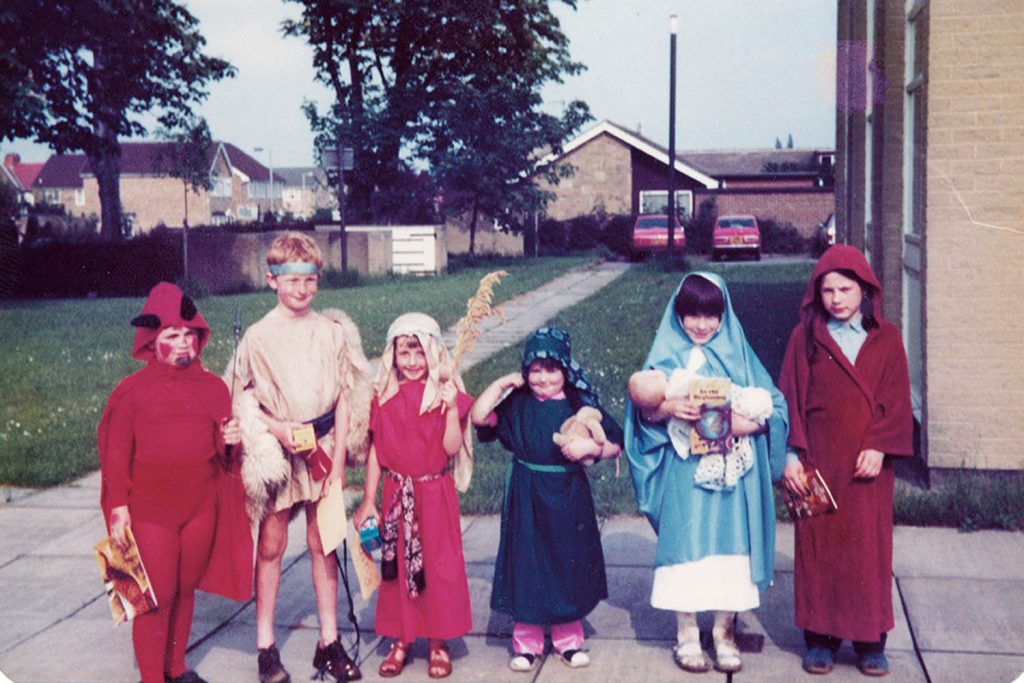
So of course Mr Smith was Jesus. With a full-size wooden cross over one shoulder, he walked, wizened, at the head of the Procession, naked but for an adult-sized cloth nappy and a cardboard crown of thorns. Talk about traumatic. These days someone would call social services. Other eyewitnesses swear he wore an anorak but I can’t separate the memory from the scariest yet most familiar page of the children’s Bible, an unnecessarily detailed pastel drawing of the tortured Jesus covered in blood.
Once safely into the grounds of St Mary’s, the grownups would peel off into the church to sit on polished Mousey Thompson pews, thinking holy thoughts and gazing at the church’s lovely stained-glass windows while me and my brother got carpet burns from the spiky mat in the adjoining hall doing Jesus-themed crafts with Mrs Birch. On Good Friday, church was from noon till 3pm, 3pm being the time the Bible says Jesus actually died and the earthly temple curtain spontaneously tore in two. Three hours is a long time to be solemn when you’re a kid and on Good Friday the main thing you’re meant to be is solemn.
But three solemn hours in a row? After the mortification of the misery march? There are only so many papier mâché tombstones you can make without wanting to overthrow the tables in the temple yourself.
For much of my childhood I was enveloped by the reassuring annual customs of primary school and the Christian calendar. The magic of Father Christmas and the omnipotence of God merged blissfully in my impressionable little brain. Life followed a pleasing pattern of constantly reinforcing rules and rewards, where everything chimed beautifully like the lively songs from our hymn book Come and Praise thumped out on the school piano. Good girls don’t get the luxury of grey areas. It’s best just to say thank you and sing along for as long as you can still breathe.
Then came secondary school, new friends, pop music, clothes. Childhood innocence tightened around me like a fist. Routines that had made me feel safe felt stifling. The stakes were suddenly higher, too. The pressure to bring home top grades sharpened just when I discovered that being clever was no substitute for being cool and pretty. I’d followed all the rules, read all the readings, coloured all the pictures and still I was nowhere near as happy or as worthwhile as I was meant to be. The whole church thing started to look like a bit of a con.
Holding my life – family, school, church – in some sort of harmony had become exhausting. A missed beat in a mean girl’s comment. That recurring off-key note in my despairing, secret thoughts. No amount of singing could drown it out. The required standard of goodness was too high, the reward too distant, the effort too great. Puberty gave me an out – I could let the rules crush me or use the force of their grip to propel myself out.
And so it was that on the fateful Good Friday when I was 12, part way through the solemnity crafting marathon, Mrs Birch sensed a restlessness in the room. She commanded us to follow her outside and lined us up by the green vestry door. From a well-used Tupperware box, she ceremonially placed a hard-boiled egg on the floor in front of each of us. She carefully explained the terms of the race – stay on the right path, complete the full course, she who doth touch her egg with her hands shalt be banished, and so on. Mrs Birch raised her hand to the heavens. Ready, steady, go. Dutiful even then, off I went.
And that’s how I ended up on all fours, with bloody knees and a grazed nose, nudging a sad little egg with my face along the Yorkshire stone path between the church walls and the gravestones in the name of God. As I slowly clawed my way to a miserable destiny in last place, with the jeers of people I’d naively considered friends ringing all around me, I heard a voice above the clamour. In quiet calming tones of the purest, earthly common sense, it said: “FUCK THIS.”
Embarrassment is to shame what going to church is to having faith – the visible public hoo-ha that maps to all manner of intangible, private goings-on. The tedious drumbeat of religious rigmarole kept up the momentum of shame that stalked my childhood. I was ashamed of not being grateful enough. Of being too loud and too sullen. For knowing too many answers and for not having all of them. Of asking too many questions and not asking the right ones. Of being too competitive and not trying hard enough. Of being too grumpy and too silly. Of laughing at the wrong time and at the wrong things.
I miss the familiarity of the fervent Anglicanism that shaped my childhood. Religion is a formidable organising principle in a disorganised world but, unlike Grandpa, I was never able to square the private belief with the public shenanigans. In the end, church was just a bunch of people doing daft things to prove how holy they were. So instead, I’ve been freestyling for decades. Life without religion is discordant, chaotic, lonely sometimes, and free. I much prefer Easter to Christmas now. The weather is nicer too.
Liz Moseley is an editor and partner at Tortoise.
This piece was taken from Echoes, the 12th edition of Tortoise Quarterly, our short book of long reads. Print copies are available for purchase on the Tortoise shop – members get a special discount.
Illustration Chloe Watts