Warm Pacific waters affect weather but also economics all over the world
- Two students and a man in his 50s were killed in a stabbing attack in Nottingham.
- Alexander Lukashenko said Belarus has received tactical nuclear weapons from Russia.
- Cormac McCarthy, author of The Road and No Country for Old Men, died aged 89.
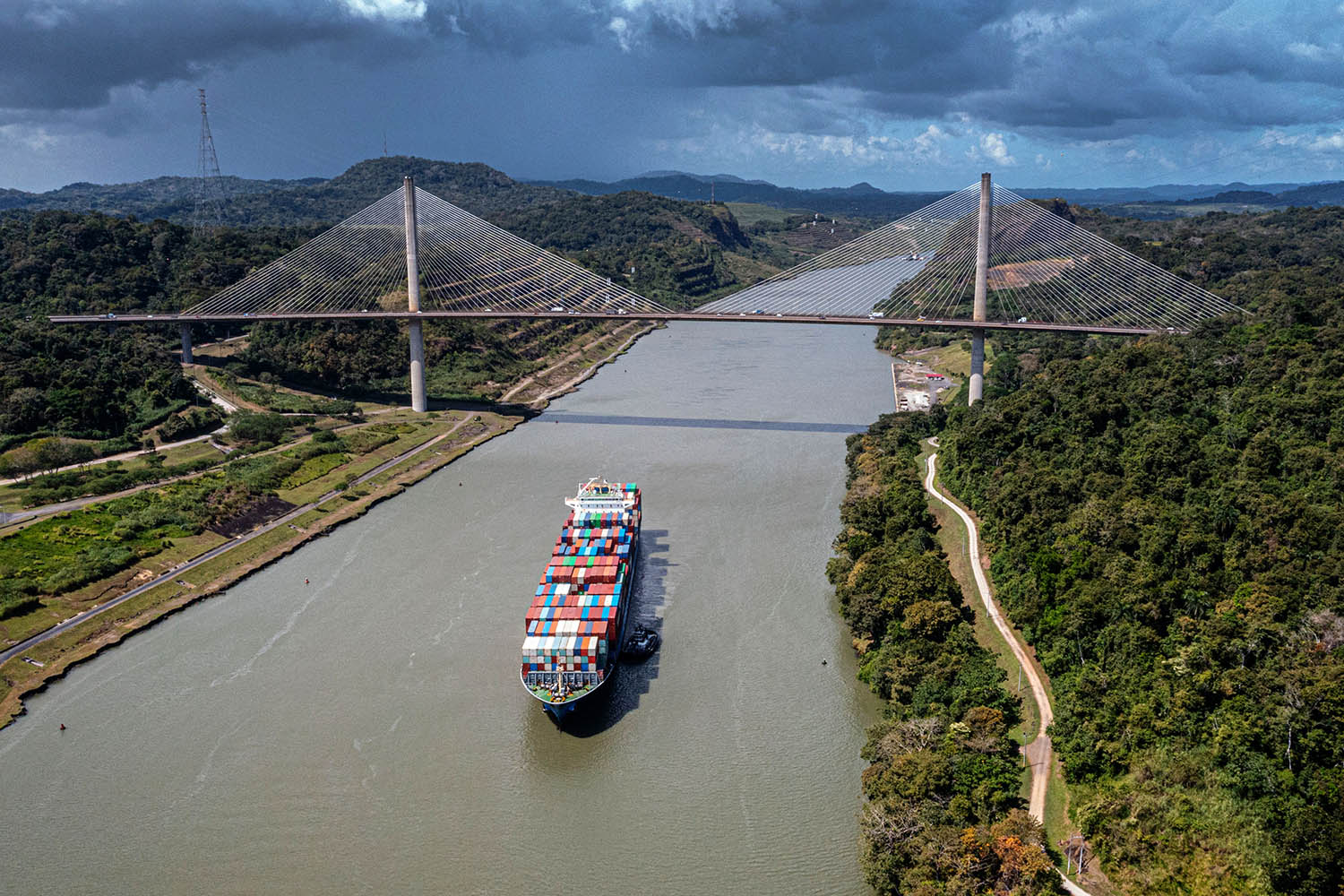
Last month the Panama Canal Authority cut the maximum draft of cargo mega carriers passing through its locks, and one of the world’s biggest shipping companies added a $500-per-container Panama Canal surcharge.
So what? Both developments are responses to falling water levels in the canal, forecast to go on falling because of an El Niño effect (details below) confirmed by US scientists last week and likely to be intensified by anthropogenic warming.
If governments ever assemble a meaningful response to rising ocean and atmospheric temperatures it will be because of the opportunity cost – or just the cost – of not doing so, and the canal’s reaction to the first big El Niño event in four years is a case in point.
- The authority’s draft reduction from 50 to 46 feet means shipping companies have to use smaller vessels or lighten their loads by up to 40 per cent.
- That limits economies of scale, and the $500 surcharge imposed by Hapag-Lloyd is a way of passing the cost on to customers.
Higher shipping costs will fuel inflation, and so will other El Niño side-effects if past experience is any guide:
- Coffee prices will rise if crop yields fall as expected because of lower-than-usual rainfall over the next five years in Ethiopia and Brazil.
- Sugar exports from India, the world’s second-largest exporter, have been halted until the first half of next year at the earliest because of expectations of a weak monsoon. The sugar price in Mumbai is already at an 11-year high.
- Australian wheat, Malaysian palm oil and Peruvian anchovies are expected to rise in price because of drought and ocean warming respectively.
Last time. A 35 percent increase in the cost of irrigation led to a similar increase in the price Indian farmers had to charge for rice during the El Niño event of 2015-16, Bloomberg reports. Overall, according to a study in Science, that cycle accounted for a 3.9 per cent rise in global non-energy prices over five years, and a 3.5 per cent increase in the price of oil.
This time.
- Dartmouth College researchers forecast a $700 billion hit to the US economy between now and 2028 if the pattern of 1982-82 and 1997-98 is repeated. Each of those El Niños suppressed medium-term US GDP growth by an estimated 3 per cent.
- Increased reliance on solar power may deepen the energy trap in developing and low-latitude countries where demand for air conditioning peaks on hot evenings as solar capacity goes offline.
- World nickel prices – and thus EV battery costs – could spike if heavy rains block access to Chile’s mines, as they have in El Niño years before.
Hot and cold. The El Niño effect is a periodic warming of surface waters in the equatorial Pacific, pushed eastwards towards the Americas by ocean currents and trade winds that can weaken or reverse from their usual east-west pattern. Results can play out over several years and include heavier-than-usual precipitation and flooding along parts of the eastern Pacific seaboard, and drought from the Sahel and southern Africa to India, Southeast Asia and northern Brazil.
Big numbers
$84 trillion – estimated economic losses that will be attributable to El Niño events over the whole 21st century
$5.7 trillion – estimated cost to world economy of 1997-98 El Niño
10 – GDP growth in percentage terms foregone by Peru and Indonesia as a result of each of the last two big El Niños.
98 – percentage chance that the next five years will be the warmest in recorded history, per the World Meteorological Organization.
El Niño and anthropogenic global warming are separate but related. The latter boosts the former, as one expert puts it, like an escalator.