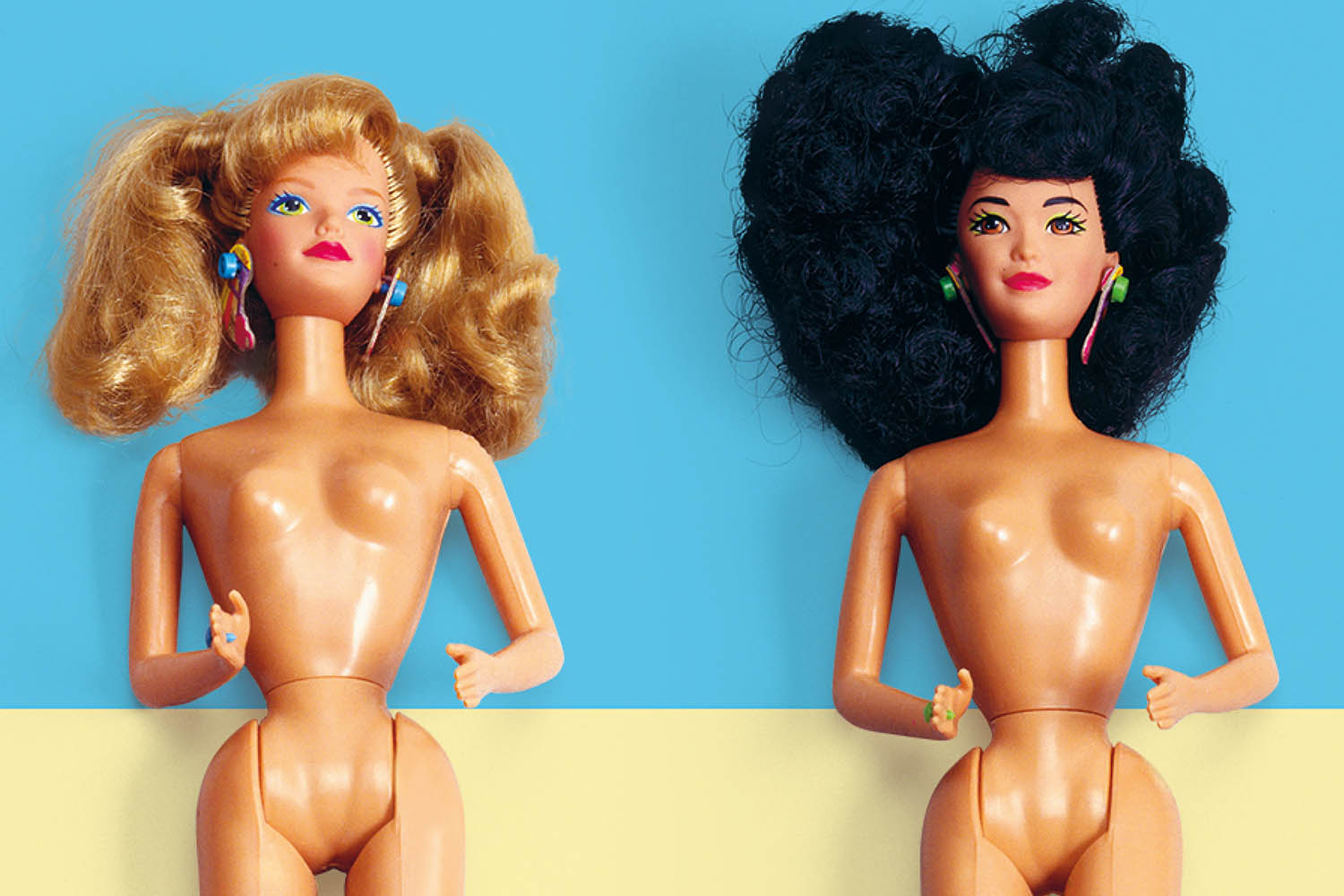
Barbie is back. Hattie Garlick on the doll who has infatuated and infuriated girls for six decades
A woman is running the country. Julie Hayward, a Liverpool cook, has just brought – and won – the first successful case under the Equal Pay Act, demanding the same wage as her male colleagues. I am six and if I’m hazy on the politics, I feel their ramifications in one rule that holds firm in our home: Barbie is banned.
My mother will have none of her. We are forging a future in which women’s feet are no longer perpetually arched into stilettos, hot pink mouths into ingratiating smiles. Barbie is a tacky, tottering anachronism. And yet …
A small group huddles, hushed, around a birthday girl who is dressed like a bonsai-sized bride and tearing through glittery paper. Over her shoulder, we get our first glimpse of the bubblegum-pink Barbie Magical Mansion. The colour suddenly drains from our Benetton dungarees and Cabbage Patch dolls.
The summer I turn 13, Aqua’s Barbie Girl plays on every car radio, in every shop, in every school disco. My transition into semi-adulthood is soundtracked by the song Rolling Stone magazine will vote the worst of the 1990s, and the lyrics: “I’m a blonde bimbo girl in a fantasy world/Dress me up, make it tight, I’m your dolly.”
A girl perches on a staircase, alcopop in hand, and says her school yearbook named her “most like a Barbie”. The rest of us roll our eyes. Pathetic, we signal to one another. A gauntlet thrown down, we acknowledge somewhere deep in our subconscious.
My daughter is born. My turn to vow protection against this plastic cipher for a system that would value the cuteness of her waist and fullness of her bra cup over her mind and heart. Zealously, I purchase Lottie dolls – progressive anti-Barbies, built to the proportion of real, stocky little girls. Soon, Lotties litter the living room. But I know, deep down, that you cannot ban Barbie. If you are born female, she slips silkily into your pre-school social life, becomes tattooed on your psyche like her own indelibly sunny make-up.
Better women than me have tried to put her back in her box. Over the past six decades, Barbie has been burnt by feminists from Berkeley to Berlin. She was pulled apart by the American Association of University Women for telling little girls who pressed a button on her back that “math class is tough” but “party dresses are fun”.
In 1993, as I was being hypnotised by the Magical Mansion’s myriad shades of pink, a group called the Barbie Liberation Organization was stalking the aisles of toy shops, ripping out her voice box, swapping it for GI Joe’s and leaving Barbie snarling “vengeance is mine”.
Yet Barbie refuses to die. Since you started reading this, around 150 dolls have been bought. The market research firm NPD crowned her the “global toy property of the year” in 2020 and 2021. No doll has ever exerted such power over us. We hate her. We love her. We love to hate her.
My generation traced our childhoods through the changing outfits into which we jammed her unchanging curves. The next has sat cultishly mesmerised by her YouTube channel (11.3 million subscribers and counting). And now her campaign for world domination is opening a new front. The Barbie movie is coming to a cinema near you this summer.
The propaganda war has already begun. As I type, photos of the cast and characters are flooding Instagram. There’s Emma Mackey from Sex Education (“this Barbie has a Nobel Prize in physics”), Sharon Rooney from My Mad Fat Diary (“this Barbie is a lawyer”), Issa Rae from HBO’s Insecure (“this Barbie is president”), Ryan Gosling from, well, everything (“He’s just Ken”). My brain is already adopting an automatic brace position and yet …
The trailers make strangely fabulous viewing. And not only for the Willy Wonka colour palette of sherbet-pink beaches and citrus-sour spandex. The film is co-written and directed by Greta Gerwig, whose previous films include Lady Bird and Little Women, and who admitted, on Dua Lipa’s podcast, that hitching her hitherto unimpeachably progressive brand to Barbie Land “could be a career-ender”.
Here’s an irony, though. As the tagline to the film’s promotional spam suggests (“She’s everything. He’s just Ken”), Barbie is the queen of career reincarnations. Since her launch in 1959, she has had more than 200 jobs. The American author Susan Shapiro has long cited this as evidence that we have her all wrong. Barbie is, in fact, “the original feminist”.
Admittedly, her first job was “teenage fashion model”. But somehow she climbed the ladder and in 1963 (the very same year the US introduced an Equal Pay Act, and a full seven before the UK had its own) she became Executive Barbie. Two years later, Astronaut Barbie was going to the Moon. An impressive pivot, especially since it would take Nasa another 18 years to send a real-life woman, Sally Ride, into space.