The 1972 Olympic Games should have marked a new beginning for West Germany. Instead they changed sport and the world forever
The death of innocence in sport has been pinned to many scandals and tragedies. Its correct location is the Munich Olympic slaughter of 1972.
In the Steven Spielberg movie about the seizing and murder of 11 Israeli athletes and officials by “Black September” Palestinian terrorists 50 years ago, General Zvi Zamir of Israel’s Mossad tells the operative charged with assassinating the plotters: “This is something new. What happened in Munich changes everything.”
The script was right. Everything changed, in Middle East politics and in sport, where West Germany had tried to overlay the 1936 “Nazi Games” in Berlin with a nationbuilding festival sold as the “Serene Olympics”. From the bloodbath of 5-6 September (five hostage-takers and a West German policeman were also killed) emerged in sport a vast security industry, turning the Olympics and World Cups into fortresses.
Somehow, dotted across the Munich story, are some of the most recognisable names in Olympic history. Footage of their triumphs remains disembodied from the reality of a new strain of terrorism as harrowing live TV.
Mark Spitz won seven swimming golds and set the same number of world records. Olga Korbut’s frail brilliance in the gymnastics hall delighted the world. A men’s 100 and 200 metres track double for Valeriy Borzov gave Soviet Russia its obligatory Olympic hero. And Lasse Viren, a Finnish policeman, won gold in the 10,000 and 5,000 metres on the path to immortality in long-distance running. Spitz, who is Jewish, was rushed away to safety in case there was a second plot to kidnap him.
Widespread doping, Cold War friction and political manipulation were already the dark subtexts of a circus erected to express West German modernity and assuage its guilt.
Two years later the Munich Games would morph into the 1974 football World Cup, which West Germany won, in the same Munich Olympiastadion where the International Olympic Committee (IOC) president, Avery Brundage, had declared “The Games must go on” after a callously brief 34-hour suspension.

In the final hours of innocence, the athletes’ village had exuded a holiday camp vibe. Unarmed West German security wore Butlin’s-style outfits and waved to sunbathers. Beyond the walls of this hippiefied Bavarian convention, trained Black September attackers were meeting in a Munich railway station restaurant to be told what the target was.
On the night of 4-5 September, eight terrorists scaled a chain-link fence carrying grenades and assault rifles in sports bags. They headed for Israel’s accommodation block. In the mêlée of the initial hostage grab they shot and killed Yossef Romano, a weightlifter, and Moshe Weinberg, a wrestling coach, whose bullet-ridden bodies lay in the apartments as the siege was laid. After a botched rescue attempt at the airport by German police, the remaining Israelis were slain when a grenade was thrown into one of the helicopters that had flown them to a waiting plane and gunfire was sprayed into the second. Five hostage-takers were also killed, with three taken into custody but then freed – an enduring source of indignation in Israel.
Fifty years on, the shock of Munich reverberates still in bitterness, political contortion, the emboldening of global terrorism and the financial cost to countries hosting global sporting events, which these days barricade themselves in compounds.
From the Montreal Games of 1976, sport assumed a defensive posture inside that Fleet Street favourite, “the ring of steel”. The 9/11 attacks in America and rise of al-Qaeda and Isis elevated fear and sent budgets into orbit. The 2008 Beijing Olympics were called “the largest peacetime security operation in history”.
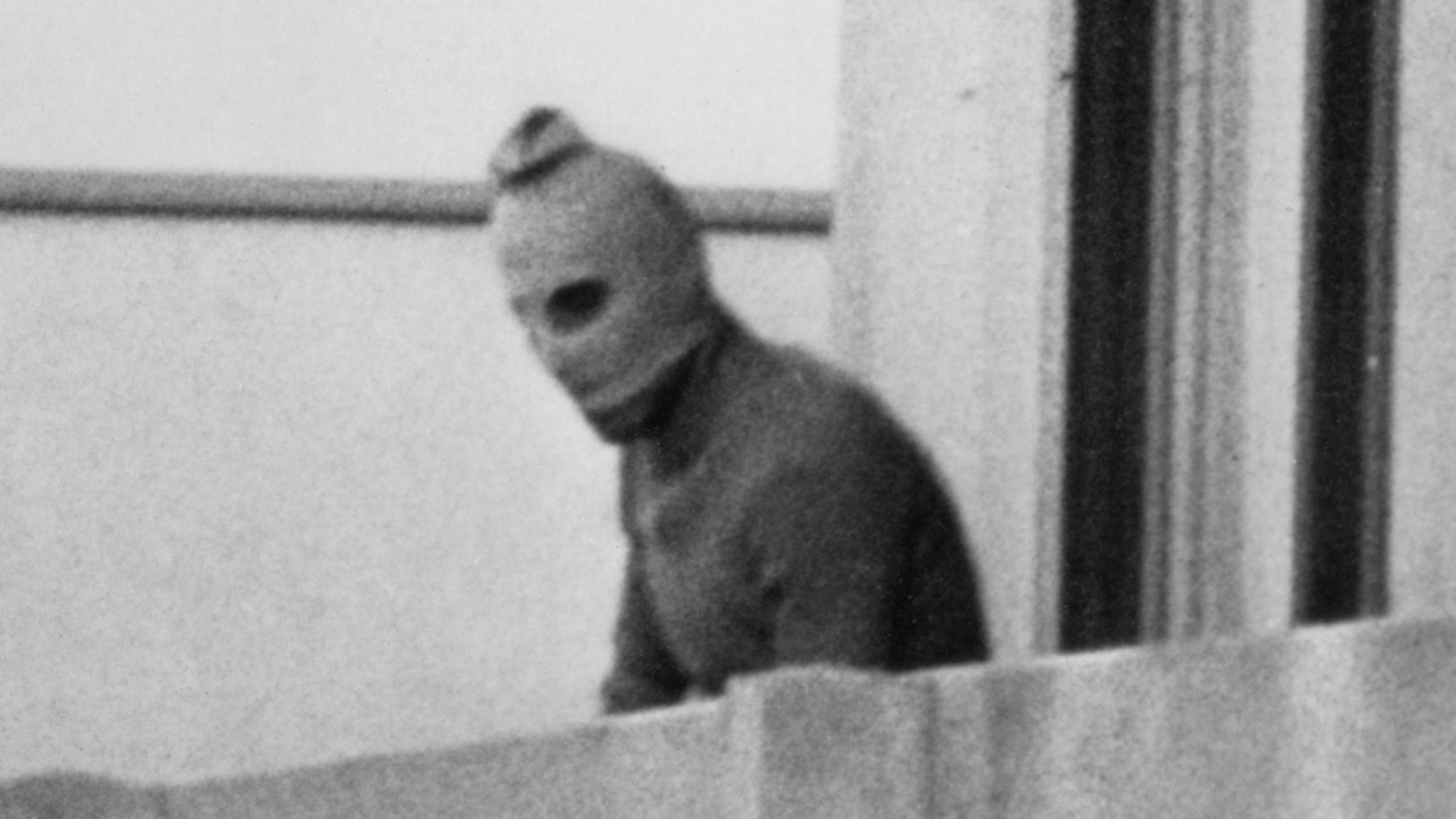
The psychic scarring from Munich is permanent. Grainy videos of gunmen in balaclavas peering out from balconies was a recurring nightmare. Always, now, horror would be just around the corner. Anxiety and dread permeated sport’s subconscious. No longer could it pretend to be aloof from war and politics.
In Spielberg’s movie, and the documentary One Day in September, Munich affirms its connection to today’s atrocities, through its pathology. A new, violent audacity was born.
The camera shots and sounds of Munich cover the gamut of creeping anguish and disassociation, from the JFK-era commentary of ABC’s Jim McKay, to the clips of athletes sunbathing and playing table tennis during the stand-off. Like all the most powerful live footage, the mind can’t unsee it.

And when German police disguised in 1970s sports gear hover amateurishly around the Israeli apartment block, we know the operation is doomed. The world watched it live on TV. So did the hostage-takers, who were primed for the attack. The juxtaposition between faltering German police on a roof in Adidas tracksuits and today’s special forces ops would astonish anyone under 30.
McKay’s sorrowful reporting was textbook broadcasting. “These strong men, sitting helpless at the point of machineguns,” he said of the Israeli wrestlers and weightlifters. Olympic virility was no defence against assault rifles.
As the Black September demand for the release of more than 200 political prisoners in Israeli jails fizzles out, doorstep diplomacy between flummoxed politicians and terrorists standing in plain sight prepares the ground for a disaster. Hostage-takers and captives are lured into a police trap, at Fürstenfeldbruck airfield, under the pretence of being flown to an Arab country.
The ambush was a travesty. Five snipers were lined up to liquidate eight terrorists. The fake German airline crew on board the escape plane saw they had no chance of overpowering the gunmen and abandoned ship. Armoured units turned up nearly an hour late.
Here too the Munich tragedy was shaped by Germany’s Nazi past. Constraints on the army’s powers and the absence of an anti-terrorist SWAT squad were legacies of German war guilt. Mossad’s General Zamir was appalled by the tactical ineptitude of the rescue operation.
With eyes and voice lowered, McKay corrected earlier claims that all the hostages had been saved. “They’re all gone,” he said.
The nine Israelis killed at the airport were Ze’ev Friedman, David Berger, Yakov Springer, Eliezer Halfin, Yossef Gutfreund, Kehat Shorr, Mark Slavin, Andre Spitzer and Amitzur Shapira.
Across the tarmac was strewn the bloodied wreckage of two helicopters: death chambers, redolent of a battle in Vietnam.

In Israel, a line was swiftly drawn from the Holocaust to the murder of Jews ten miles from the Nazi death camp at Dachau. Fifty years on, the IOC’s eagerness to resume the Games when the bodies had been cleared away is still resented. Liat Collins, a leading Israeli columnist, has written in The Jerusalem Post: “The Munich Olympics were meant to cement the image of a new, modern (West) Germany in a better, post-World War II era: a time when the sporting spirit of the Olympics and Brotherhood of Man would prevail. Instead, it became another stain in history. More Jewish blood spilled on German ground.
“The world did not know what to do with the dead Jews. It waited one day and then while Israel buried its dead, the philosophy that ‘the Games must go on’ won and the Olympics continued.”
In the Palestinian territories and beyond, commemorations honour Black September’s stated quest to draw the world’s attention to what it sees as Israeli oppression and Palestinian displacement.
The threads stretch back to Germany’s Nazi past and into the present of an Israeli-Palestinian conflict that remains lethal and unresolved. Munich is recalled by Israel as emblematic of Europe’s disregard for the Holocaust and by many Palestinians still as a desperate, forced escalation.
Nor has closure been reached on what happened next. The three surviving terrorists were captured but then released in exchange for hostages on a hijacked Lufthansa flight. In One Day in September, it is alleged that the West German government conspired in the Lufthansa hostage exchange to prevent future attacks in Germany. Of the three given heroes’ welcomes in Libya, only Jamal AlGashey escaped Israel’s retribution. He is believed to be hiding in North Africa.
“Operation Wrath of God”, authorised by Golda Meir, Israel’s prime minister, delivered extra-judicial vengeance to two of the remaining hostage-takers and an unknown number of plotters. Palestinian retaliation widened the cycle of killings.
Last year at the Tokyo Olympics, a memorial service was held at the Israeli embassy. In November, 21 members of the victims’ families demanded compensation from Libya through United Nations legal channels.
Even in Britain echoes persist. In 2014, Jeremy Corbyn was photographed holding a wreath at the Cemetery of the Martyrs of Palestine graveyard in Tunisia, near the resting places of Black September operatives. Challenged in 2018 to explain the visit, Corbyn said: “I was present at that wreath-laying. I don’t think I was actually involved in it.”
The theory of Corbyn’s unelectability was rooted in part in his affiliations overseas as well as unchecked antiSemitism in the Labour Party. Corbyn’s worldview – frozen, his critics said, in the 1970s – was widely used against him in the analysis of Boris Johnson’s 80-seat majority and Labour’s worst election result since 1935.
The Olympic slaughter of 1972 wasn’t a passing news event, confined to its time. It spread and stained the future as surely as blood soaked the Munich Games.
Paul Hayward is a contributing editor at Tortoise. His 150-year biography of the men’s England football team will be published this year by Simon & Schuster.
Photographs Getty Images