Sensemaker Daily
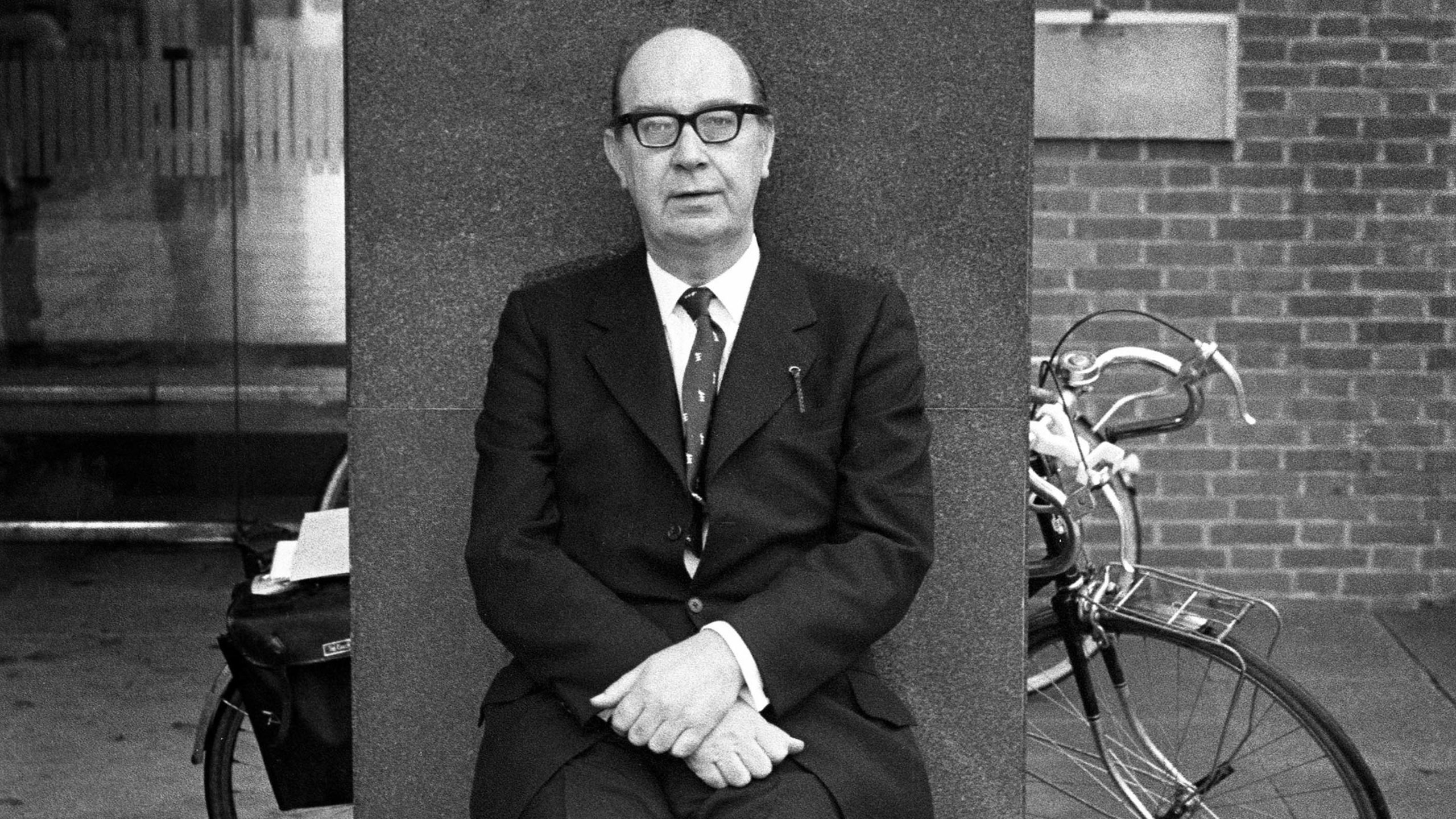
Today, 9 August, marks 100 years since Philip Larkin was born. To celebrate the centenary, Michael Henderson charts Larkin’s life in three of his poems
On the third day of 1950 a sub-librarian at University College, Leicester went to the pictures. Philip Larkin had left Oxford seven years before with a first-class degree in English, and worked in a municipal library in Shropshire before moving to Leicester. Despite publishing two well-received novels, Jill and A Girl in Winter, he felt barren. Novels required an ability to illuminate the inner lives of characters, which he found hard to do. He longed to be a great poet and, feeling old at 27, saw time torn off, unused.
What he watched in the three-and-sixes that January evening changed his life, and helped restore to English poetry a clarity that reclaimed thousands of readers intimidated by dusty intellectualism. Before the main film there was a short feature, common practice in those days, which followed a retired champion racehorse, Brown Jack. On the way back to his digs in Dixon Drive (note the name), Larkin found himself thinking about the horse. When he got home, he sketched a poem, At Grass. It was the most decisive step he ever took towards fulfilling his dearest wish.
Larkin, who was born in Coventry 100 years ago this August, had written verse throughout adolescence, and during his three years at St John’s College, Oxford, where he forged a friendship with Kingsley Amis, by times playful and combative, that was to last a lifetime. But the poems in The North Ship were prentice works, which bore the stamp of WB Yeats and Wystan Auden, who perched on his shoulder like imps. At Grass denotes the precise moment when Larkin became Larkin. He had achieved, to lift a line from one of his most widely quoted poems, “a brilliant breaking of the bank”.
When The Less Deceived, his first major collection, was published in 1955, his voice was fully formed: spare and lyrical, as original as a thumbprint. It is a voice that resounds today, 100 years after his birth: truthful, slyly humorous and thoroughly English. No writer of the past century has spoken so clearly or directly to his countrymen. Other than John Betjeman, no writer is so widely trusted, and none so freely quoted. Larkin admired Betjeman, even if, temperamentally, they could hardly have been further apart. Betjeman, a consummate television performer and all-round ham, with his golly-gosh manner and teddy bear, craved public recognition. Larkin, whether in Leicester, Belfast or Hull, where he spent the last 30 years of his life, needed solitude.
He did not acquire his freedom by revolutionary means. The man now acknowledged to be a master reached maturity by degrees, and made no secret of his debt to another master, who had died 11 years before Yeats, in 1928. Thomas Hardy taught him to sing in his own voice, and for the rest of his days he never forgot Hardy’s declaration: “The ultimate aim of the poet should be to touch our hearts by showing his own, and not to exhibit his learning, or his fine taste, or his skill in mimicking the notes of his predecessors.” Larkin endorsed that precept in every line he wrote. In the context of 20th-century poetry, therefore, with its emphasis on dislocation and wilful obscurity, perhaps he was the true revolutionary.
At Grass is a poem in five verses of six lines, beginning with the casual observation: “The eye can hardly pick them out/From the cold shade they shelter in”. This is not a realm of symbols or classical allusions. Rather, it is a snapshot of the quotidian world that Larkin, like Hardy, was to make his own. Two horses are cropping grass, their “Cups and Stakes and Handicaps” largely forgotten triumphs of 15 years ago, though “Almanacked, their names live”. “Almanacked”! Pure Hardy.
In the final verse he supplies a beautiful image of these thoroughbreds as they “stand at ease, or gallop for what must be joy”. It is that word, joy, which lights up the poem like a candle, for it is not a quality often associated with Larkin, painted so often as the Hermit of Hull. Must also suggests something suspected, not known. Is the poet ascribing to these proud animals an emotion that doesn’t stir his own blood? Is he no more than an outsider, like Tennessee Williams, who once said “I feel so excluded”?
Too much can be made of Larkin’s self-exclusion. There is joy in the poetry, and any estimation of his gift begins with a lyricism all the deeper for its lack of sentimentality or verbal trickery. Where Charles Tomlinson identified a “tenderly nursed sense of defeat”, and Al Alvarez heard notes of “the commonplace”, readers more sensitive to Larkin’s emotional temperature have always recognised something more profound. In his exalted moments he shared Schubert’s facility for blending joy and melancholy in language of unforced elegance.
Like Schubert, Larkin saw sadness in all things, and never carried unwanted freight. We spot that emotional ambiguity in The Trees, with the injunction to “begin afresh, afresh, afresh”; that repeated adjective emphasising a sense of regeneration. It is there in Love Songs in Age, with “the unfailing sense of being young, spread out like a springwoken tree”. In To the Sea, an evocation of old-fashioned summer hols, families frolic on the sands, the young looking after the old “as they ought”.
And who other than Larkin would end Home is so Sad, a ten-line poem of wrenching sadness, with a two-word sentence, “That vase”? All the melancholy of the world in two syllables, as we hover between major and minor keys. Yet even here there is joy of a kind, for home brings pleasing associations as well as thwarted hopes (“a joyous shot at how things ought to be, long fallen wide”). The poet is celebrating the hidden moments in unheralded lives that mean so much to those who live them, far from Achilles at Troy or the Celtic twilight.
There is one poem where joy sings out with unfettered freedom. Sidney Bechet, the virtuoso of clarinet and soprano saxophone, was one of Larkin’s favourites from the golden days of New Orleans jazz, and the poem which decorates the musician – “oh, play that thing!” – has become one of his most familiar, not least as a rallying cry for Larkin’s fellow trad-jazzers, like Amis. “On me”, goes the line that is appropriated most frequently, “your voice falls as they say love should,/Like an enormous yes”.
Larkin’s love of jazz, defined for him by Bechet, Louis Armstrong and Bix Beiderbecke, is sometimes mocked by critics who scorn his conservatism. In his decade as a reviewer for the Daily Telegraph, Larkin left readers in no doubt which musicians he liked and, just as expressively, which he did not. He was a heretic, which Oxford has been turning out for centuries, and will never be forgiven by those hepcats, grown old now, for whom Charlie Parker lighted a stairway to the stars.
As with his poetry, however, those sceptics come up against the brick wall of his prose, for Larkin was the most sparkling writer on popular music on either side of the Atlantic. “The passionless creep” of a Miles Davis solo certainly rings a few bells, and should ring a few more. Also, the trumpeter’s notes “drooping like Dali watches”. Not just witty, but perceptive. He didn’t care for Thelonious Monk, either – “the elephant on the piano”! Cock an ear, and then say he’s wrong. Monk couldn’t play an octave without squashing the notes like grapes in a tub.
Jazz for him was a thing of innocence – and joy, never meant to be part of the modernist movement, which “helps us neither to enjoy nor endure”. As with Auden, whose later, American work he considered to be self-consciously aloof, poetry about poetry, he found in John Coltrane and Ornette Coleman a deliberate ugliness which betrayed the pioneers he loved so much.
In the superb introduction to All What Jazz, a collection of his essays, Larkin recalls how he and others of his generation, “men whose first coronary is coming like Christmas”, were drawn to music which spoke to them with a grace and ease they struggled to hear in those who came after.
At the end of every working day, library duties done, Larkin would pour himself “three goes of gin”, and caper round his lounge like an infant to the stuff he and Amis gorged on at St John’s. He could live for a week without poetry, he used to say, but not a day without jazz. Armstrong and Ellington to him were Chaucer and Shakespeare. They created and refined the magical pageant he honoured in that Bechet memorial “as the natural noise of good”.
It was joy, and there was nothing provisional about it. In his imagination he was galloping, like those horses he caught on a flickering screen in Leicester when he wasn’t sure he would ever make a poet.

By 1964, when Larkin’s second major volume of verse appeared to the sound of trumpets, there was no doubting his standing. The Whitsun Weddings is a small, perfectly formed book starting with Here, a reflection on life in Hull, where he moved in 1955 to take up the post of chief librarian at the university, and ending with An Arundel Tomb, a meditation on medieval death in Sussex: “What will survive of us is love”. The poems not only read beautifully, they also sit well together, and the one which lends its name to the collection is his very own Matterhorn.
Harold Pinter and Leonard Bernstein, very different to Larkin in background and temperament, loved this poem so much they could recite it from memory. Ian McEwan, writing about the final days of Christopher Hitchens, revealed how his friend asked him to read it to him, and explain the cultural references to his American son. As Hitchens understood, it is a poem to live and to die by.
Opening with words that could hardly be more simple (“That Whitsun I was late getting away”), Larkin describes a rail journey from Hull to King’s Cross with a detail and sense of motion which, verse by verse, assumes an almost physical sensation. The celebrated closing lines, of “an arrow-shower/Sent out of sight, somewhere becoming rain” stand comparison with Auden’s The Fall of Rome, Yeats’s Byzantium and Sunday Morning by Wallace Stevens as a memorable concluding image. Larkin’s eye and ear ensure that a rail journey becomes a transcendental event.
He caught the train at Whitsuntide in 1955, during that first season in Hull. The previous year Amis had published Lucky Jim, which the author dedicated to his old Oxford friend, as well he might. Jim Dixon, the novel’s hero, borrowed his name from the street in which Larkin lived, and Margaret Peel, Dixon’s girlfriend, was based on Monica Jones, the university lecturer who was Larkin’s flesh and blood partner. Entrusted with the manuscript, Larkin helped Amis to reshape the book, which took off like a rocket. It was a literary phenomenon in a post-war Britain gripped by rationing and national service, and still drinks like a sapid claret. Lucky Jim may have been composed by Amis, but it was Larkin who made sure the band was properly tuned.
A poet by inclination, Amis had lengthened his novelist’s stride by 1964. He was even a celebrity, featured in popular newspapers because his books sold. Larkin, meanwhile, the erstwhile writer of fiction, had settled into life in the library, stealing a few weeks each summer with Monica in Scotland or Northumberland. When The Whitsun Weddings was published, therefore, the relationship between the collaborators had undergone a readjustment that often occurs when one friend is deemed to be more successful than the other. Their association, though warm, remained geographically distant after Oxford, as Larkin sought a sequestered life which enabled him to write the poetry he wanted to. Hull, he reckoned, correctly, was sufficiently remote from the world of literary London for him not to be pestered. It was by the North Sea, “untalkative, out of reach”, and that suited him fine. “The Laforgue of Pearson Park”, he called himself, protected from prying eyes by shelves of books and records.
Hull helped him modify the voice which marks him as the honest chronicler of that post-war world, just before ancestral memories were swept away by the social tornado of the Sixties. It is a landscape of low terraced houses, grain-scattered streets, raw estates, grim head-scarfed wives, young mothers at swing and sandpit, husbands in skilled trades, and rained-on streets and squares. The cut-price crowd hanker after cheap suits, sharp shoes, red kitchenware, electric mixers, toasters, washers and driers, while their children lick iced lollies. It is not a conventionally romantic view, yet Larkin manages to imbue the working and recreational routines of ordinary folk with meaning and occasional rapture, even as “something is pushing them to the side of their own lives”.
The Whitsun Weddings begins as a five-finger exercise for a poet who has mastered the keyboard of provincial life. He begins his journey at 1.20 on a sunlit Saturday, “all sense of being in a hurry gone”. The three-quarters empty train runs behind the fish dock and crosses the Humber estuary, “where sky and Lincolnshire and water meet”. Then the melody develops, and Larkin finds harmonic depth as he looks out at farms, canals and acres of dismantled cars. Each station brings a new group of newly-weds to the train from banquet-halls, cheered into married life by fathers with seamy foreheads, uncles shouting smut, and mothers loud and fat.
An Odeon goes by, then a cooling-tower and – one of those touches Hitchens wanted McEwan to explain to his son – “someone running up to bowl”. Larkin imagines London’s postal districts packed like squares of wheat before “this frail travelling coincidence” ends with that arrow-shower, an augury of fertility, though not for Larkin. He acts as Everyman, observing a world that is familiar yet one he knows he can never join. It is not a sad scene. It is one of affirmation and, for the young couples sitting side by side, hope. Those final lines are a secular blessing.
Nobody who loves England as England should be loved can fail to respond to The Whitsun Weddings. It may not be Hardy’s Wessex, or Housman’s blue remembered hills, but its wistful definition captures a time and place as faithfully as a photograph. It’s an England of the recent past, which will never come again. Whitsun, or Pentecost, when the Holy Spirit was revealed to the disciples, is a tradition lost in a world that has turned its back on the Gospels.
Lancashire and Yorkshire used to play cricket every Whitsun, and woe betide the batsman who tried to hook before lunch. Now the last weekend in May is just another secular holiday, and the someone running up to bowl wears coloured togs, not a knitted sweater.
Larkin, no believer, nevertheless understood that customs forged over centuries of communal life weaved the fabric of a nation. When those links are sundered, memories become vaguer and the rituals handed down like heirlooms eventually cease to have meaning, a process of willed forgetfulness which diminishes us all. This is the essence of Larkin’s conservatism, not the admiration for Margaret Thatcher or the performative racism to be found in letters to Amis and Robert Conquest.
His England was a kingdom of the imagination. Invited to write a poem by the Department of the Environment in 1971 he supplied Going, Going, in which he predicted an ignoble prize for England as “first slum of Europe, a role it won’t be so hard to win with a cast of crooks and tarts”. As an adolescent he had seen the devastation in Coventry wrought by the Luftwaffe. After the war he lamented the wilful destruction of civic planners, assisted by politicians driven giddy by illusions of progress.
Casting an eye back to the Great War in MCMXIV he saw “fields shadowing Domesday lines” and men, soon to be slaughtered in Flanders, with “moustached archaic faces”. There are farthings and sovereigns, tin advertisements for cocoa and twist, and differently-dressed servants tending to dust behind limousines. He was too young to know that world but grew up in its ruins, and felt its loss, just as he mourned those symbols of his own vanished England, “the shadows, the meadows, the lanes, the guildhalls, the carved choirs”
In Church Going, from his Belfast days, he wonders “who will be the last, the very last” to seek a place of worship for its original purpose, finding in churches the reassurance that comes from a shared cultural history. He finds that communality in Show Saturday, prompted by a visit to an agricultural parade in Northumberland. “Men with hunters, dog-breeding, wool-defined women”. This is the backbone of the country, in his eyes; an old country that is going, going. The poem ends with a headmasterly bromide: “Let it always be there”.
Alfred Brendel has said that Beethoven composed 32 sonatas for piano, and not one is insignificant. The Whitsun Weddings has 32 poems, and each one repays our attention. In the flagship work he composed his masterpiece.

Writing poetry, thought Larkin, was “like trying to remember a tune you’ve forgotten”. After the publication of High Windows in the summer of 1974 he was piping on a broken reed. He was 51, no great age, yet he behaved like an old man. Overweight, balding, increasingly deaf, and fed up with never-ending arguments about cuts to the library budget, he took so completely to strong drink that each night became an alcoholic embarrassment.
Outwardly he was successful, which made the loss no easier to bear. He edited The Oxford Book of Twentieth Century English Verse (Hardy leading the way), chaired the Booker Prize panel, received the Gold Medal for Poetry and the Shakespeare Prize in Hamburg, and was made CBE. Twice he turned down the chance to become Poet Laureate, and drain butts of sack. Inwardly he lamented the loss of the gift which had made his name, and at every turn he glimpsed the Grim Reaper. After a rare visit to London in 1977, to see Larkinland at the National Theatre, he told Amis “it no longer seems like my life”.
Emotionally he had been trapped for years between the Scylla of Monica Jones, his long-time companion, and the Charybdis of Maeve Brennan, a gentle library assistant. Plumping finally for Monica, who had sharper claws, was neither wise nor good. Permanently enraged, crippled by Larkin’s selfishness over two decades of dithering, she drank even more than he did. Together they sang bawdy songs at sundown, guzzling quarts of gin. It was pitiful.
The end of things had always played a part in his poetry. In Next, Please, written at 28, he spied “a black-sailed unfamiliar”, in whose wake “no waters breed or break”. Reference Back reminds us that long perspectives “link us to our losses”, while Dockery and Son posits that “life is first boredom, then fear”. A fear of death and, in Larkin’s case, a fear of life. The Old Fools, “crouching below extinction’s alp”, sit ghost-like through days of thin, continuous dreaming. In Vers de Societe the thought of evenings at home under a lamp “brings not peace, but other things”. Even Armstrong and Bechet couldn’t banish those black sails.
Robert Lowell, meeting Larkin in London, found him “death-brooding”. Two old friends, Bruce Montgomery (who wrote crime novels as Edmund Crispin) and Patsy Strang, had poured themselves into the grave, and Larkin, in and out of hospital with all manner of ailments, was counting the days. Then, in November 1977, his mother Eva died, and he responded by completing a poem he had been scratching at for three years.
When the Times Literary Supplement printed Aubade on 23 December 1977 it was an event. As Alan Bennett recalled, “you asked friends whether they had read it”. Here was Larkin, supposedly washed up on some Apollonian shore, reappearing with vine leaves on his brow. It is an overwhelming poem, which is very hard to read. Nevertheless it has to be read. It is the last great poem he finished, and in the 45 years since its publication it has achieved a life of its own, to the extent that it is sometimes trotted out to do service for the man in full.
“I work all day” (not quite) “and get half drunk at night” (how about the other half?). What a grim way to launch a morning song. There is naught here for our comfort: unresting death, arid interrogation, total emptiness, sure extinction, and, just to make sure, the anaesthetic from which none come round. This is merciless stuff, unrelieved by the clay-white sky of dawn that reminds us postmen are prowling and work has to be done. No poet has brought back so bleak a dispatch from life’s final border.
Four o’clock in the morning, that most desolate of hours, appeared in an earlier poem, Sad Steps, when Larkin gropes back to bed after urinating, and is so startled by the moon’s cleanliness that he feels once more “the strength and pain of being young”, which can’t come again for him but for others is undiminished. In Aubade he wakes at four “to soundless dark”, and is confronted by nullity: “nothing to think with, nothing to love or link with”. There are no “wolves of memory” on this nocturnal round, not even the recollection of having been young. However, the poet in him reaches for the lyre, and to his great surprise finds a tune. At death’s door, or near enough, he rediscovers his gift.
Larkin died on 2 December 1985, a week after he had been made a Companion of Honour, and was buried seven days later at the university church of St Mary the Virgin in Cottingham. Westminster Abbey was packed for his memorial service the following February, when the congregation heard recordings of Bechet’s Blue Horizon and Beiderbecke’s Davenport Blues. Jill Balcon, widow of Cecil Day-Lewis, read Love Songs in Age, Church Going and An Arundel Tomb. Ted Hughes, the Poet Laureate, read “Let us now praise famous men”.
Anthony Thwaite’s edition of the Collected Poems in 1988 was received triumphantly. However, when the Collected Letters, also edited by Thwaite, were released in 1992, accompanied by Andrew Motion’s authorised biography a year later, the revisionists pounced. Lisa Jardine of Queen Mary College, University of London, announced she had no time for his Little Englander attitudes. Tom Paulin, a Northern Irish poet and house critic on BBC2’s Late Review, thought the letters revealed a sewer flowing beneath a national monument. Larkin’s racism was presented as the effluence of a bigot rather than (in most cases) an exaggerated performance designed to amuse friends who, knowing his fondness for dark humour, recognised the tone.
Tides go out, as surely as they come in. Martin Amis, writing of those snipers who thought Larkin and his father were racists, observed that while they may have known what a letter was, they didn’t seem to understand the nature of a correspondence. Clive James and John Banville, among others, wrote marvellous essays on the poetry. James Booth, professor of English literature at Hull, published a memoir, Life, Love and Art, which makes a handsome pendant to Motion’s biography. In 2016 Larkin finally joined Hardy in Poets’ Corner at Westminster Abbey.
Ben Brown wrote a play, Larkin With Women, which was presented at the Stephen Joseph Theatre in Scarborough. Audiences roared. It was funny. Tom Courtenay, a Hull man, and Larkin fan, performed Pretending to Be Me in the West End. A book of Larkin’s photographs, The Importance of Elsewhere, showed him to have been a rather good snapper. The letters to Monica Jones were published and last year John Sutherland, who studied English at Leicester under her supervision, wrote a memoir of his own, designed to draw the lady from the wings and put her centre stage.
Thwaite and Motion, who observed Larkin at close quarters, have said he was the wittiest of men. Ruth Bowman, an early lover, found him “the best company in the world”, while noting that “depression and melancholy were more natural to him than happiness and optimism”. For those who worked under him in the Brynmor Jones Library he was an ideal boss, thorough and fair-minded. In any summation of his life these testimonials constitute first-hand evidence. No witness has ever offered evidence of prejudice in his personal dealings (as opposed to contumely he heaped upon victims in the magnificent, bilious letters), or of bias in his work.
“They want talent,” Thomas Mann wrote of the reading public in Felix Krull, “which is in itself something out of the ordinary. But when it comes to the other oddities that are always associated with it, and perhaps are essential to it, they will have none of them and refuse them all understanding.” Yet Larkinites do understand. In this centenary year they will read afresh the poems, which, as Motion has written, represent “one of the means by which this country recognises itself”.
There was an amusing example in the pilot programme for Endeavour, the television drama which takes Inspector Morse back to his greenhorn days in the Oxford City Police. When Morse, played by Shaun Evans, was shown to his quarters in a dingy boarding-house, the landlady told him “this was Mr Bleaney’s room”, and in thousands of homes people familiar with the poem enjoyed a hearty chuckle. It looked like Bleaney’s room, too, where the lonely man plugged “at the four aways”, and “watched the frigid wind tousling the clouds”.
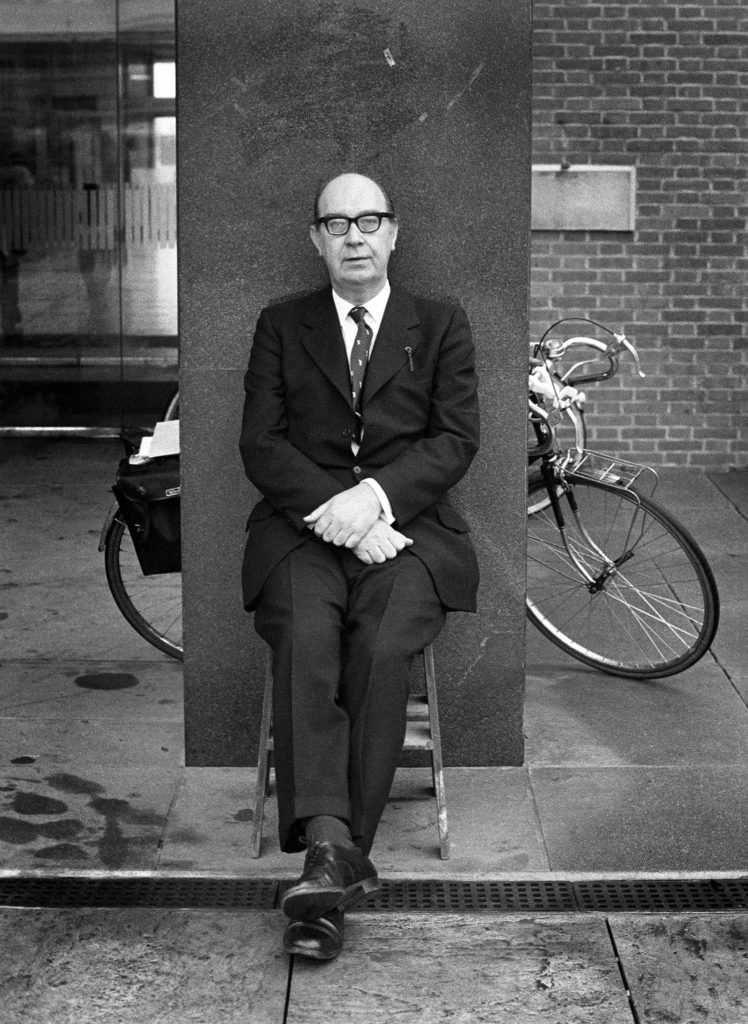
Larkin has no need of prizes, awards or statues. His work, rooted in the time-honoured foundations of memory and experience, has entered so naturally into our national conversation that readers young and old will continue to absorb it whether or not it comes with official sanction.
All along he was the less deceived. Nobody saw more clearly what was happening in university common rooms, where a disinterested love of books no longer offers a reliable guide to professional advancement. He would not be surprised to know that, four decades after his death, tutors are encouraged to interpret the words of writers through the lens of their own political, racial and sexual obsessions, thereby breaking Blake’s rule: “He who binds to himself a joy doth the winged life destroy”. How Larkin mistrusted “the emergence of English literature as an academic subject, and the consequent demand for a kind of poetry that needed elucidation”. Every poem he wrote served as a rebuke.
“Importance in literature,” Amis wrote in 1983, “is unimportant. Good writing matters, and only good writing.” If that is so, and it must be, then the poetry of this wilful, death-haunted man, a reflexive racist, maudlin sot, and devourer of pornography, represents the most glowing contribution to the English language since the war. Let it always be there.
Michael Henderson is a journalist and sports writer. His book, on cricket and Englishness, is That Will Be England Gone.
All three poems can be found in Philip Larkin: Collected Poems, edited by Anthony Thwaite, Faber & Faber, 2003
Photograph Jane Bown / National Portrait Gallery