
As Britain boils in record high temperatures, the Conservative leadership hopefuls don’t seem to have grasped the urgency of reaching net zero
Margaret Thatcher was one of the first political leaders to warn about the dangers of climate change. Under Theresa May, the UK’s net zero target became law. Yet green Tories appear elusive in the contest to succeed Boris Johnson.
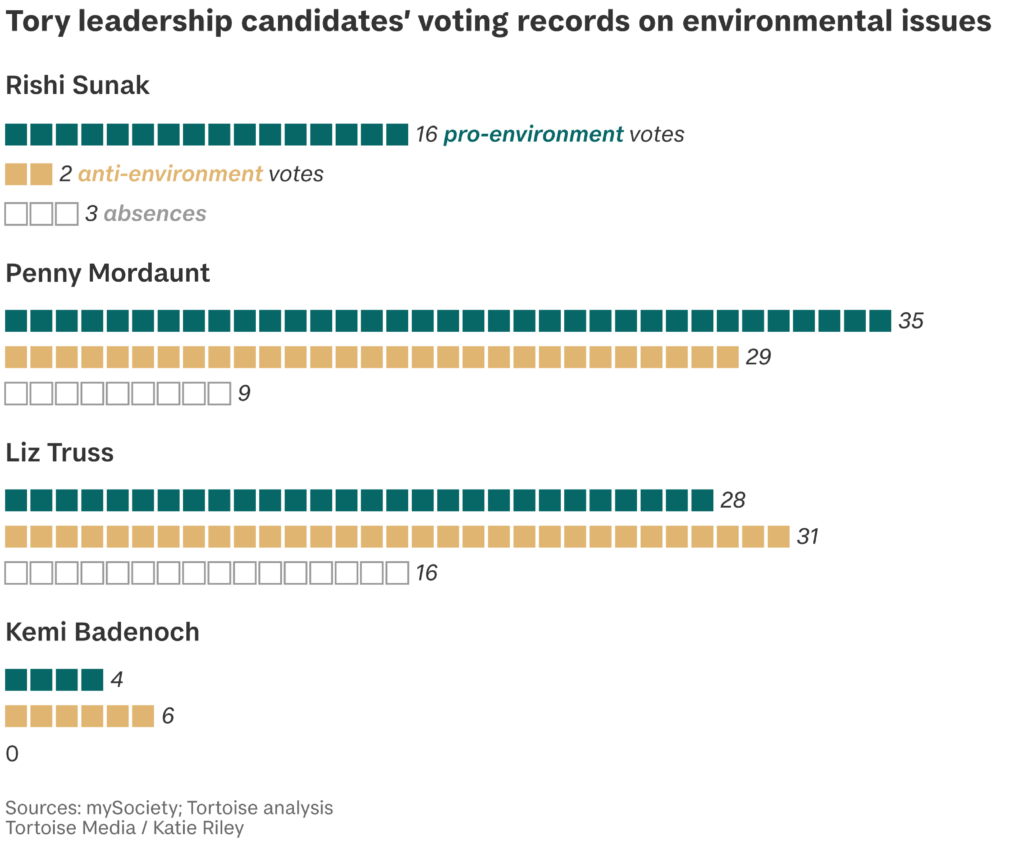
Of the four candidates still in the race, there’s only one, Kemi Badenoch, who, after two recent U-turns, has said she does not support reaching net zero by 2050. The others have been lukewarm though, prompting a warning from Cop26 president Alok Sharma this weekend: “anyone aspiring to lead our country needs to demonstrate that they take this issue incredibly seriously”.
As a heatwave underlines the shocks climate change can deliver even to wealthy countries, what does a green brand of Conservatism look like?
Not much like the US. British political parties tend to feel a gravitational tug from US and Australian politics, where right-wing parties have made climate change a wedge issue. But not on this topic.
“If you look at the Conservatives and the way the party has moved to the right, they have never really moved away from the climate consensus, at least rhetorically,” says Matthew Lockwood, senior lecturer in energy policy at the University of Sussex business school.
Dr Lockwood notes this may be connected with the relative weakness of fossil fuel industries in the UK, unlike the US and Australia.
A social contract. The Tory philosopher Edmund Burke wrote of society as a contract between past, present and future generations. Sam Hall, director of the Conservative Environment Network, suggests that: “Environment is one of the most obvious applications of the intergenerational compact Edmund Burke came up with – the notion of stewardship.”
A Red Wall vote winner? “Net zero is not a fad; it is a unique opportunity to bring industry back to the Red Wall,” Ben Houchen, the Conservative mayor of Tees Valley wrote in the Times last year, noting plans to build a carbon capture project on the site of Redcar’s former steelworks. Protecting the environment could also help campaigns in marginal seats against the Lib Dems, who made sewage dumping a dividing line in local elections this spring.
Polling suggests that Tory members care relatively little about climate, or at least about the net zero goal: just 4 per cent identify it as a priority, behind winning the election, immigration and the cost of living, according to YouGov.
Yet an overwhelming majority (94 per cent) of the British public believes climate change is real, according to a poll carried out for Tortoise earlier this year, which found that concern about the negative impacts of climate change is high.
But the polling by Stack Data Strategy, who interviewed 2500 people in April, also found the public split over whether they would be willing to pay higher taxes in order to tackle climate change, with 37 per cent in favour and 37 per cent against.
A determined Conservative turn away from climate politics is unlikely. Abolishing the net zero target would require sufficient political energy to change the law. A greater risk is a Tory prime minister who allowed Britain’s energy policy to drift. In the short-term, climate policies are vulnerable in the face of rising energy bills (as they were when David Cameron reportedly told aides to “get rid of all the green crap”).
“You could get a Tory like Rishi Sunak, who isn’t actively hostile but isn’t that interested,” Dr Lockwood says. “There is a Conservative impulse against intervention, which you see with the electrification of vehicles and insulation.
“The view on electric vehicles is that people are already buying them. The Treasury is quite sceptical on energy efficiency – people should be doing it anyway.”
Britain is ahead of many other countries when it comes to decarbonizing. Greenhouse gas emissions in the UK are down 47 per cent on 1990 levels and have been falling consistently for over a decade.
But there are still big gaps, from surface transport – which is now the largest source of emissions in the UK – to land, where more agricultural land needs to be converted so the countryside can be used to lock away carbon.
Fixing these gaps, and doing it in time to keep swaths of the world habitable for humans, will need determined leadership.
“In the past when we have identified forms of pollution we have shown our capacity to act effectively,” Thatcher told the Royal Society in 1988. It’s up to her heirs to prove that.
Fossilised
The world’s biggest economy has once again been stalled by West Virginia (38th biggest state in the US by population, 2nd biggest coal producer). This time it is Democrat senator Joe Manchin, who has refused to support his party’s climate plans. At the end of last month the Supreme Court limited the US Environmental Protection Agency’s ability to curtail emissions, in a case brought by 19 Republican states led by West Virginia. Blocked by the courts and the legislature, Biden says he will take executive action to tackle the climate crisis.
Woolly wonders
It’s the biggest land animal in Europe, a star of Palaeolithic cave paintings that was saved from extinction by zoos. This week, a trio of wild bison joined Exmoor ponies, Iron Age pigs and long-horned cattle in the Kent countryside. The hope is that the three females will help re-engineer the landscape of West Blean and Thornden woods into something wilder, opening up trails and wallowing in dust baths to create more complex habitats for other animals and plants. It’s a small step to redressing the balance of the British countryside. The impact of agriculture and pollution means the UK has lost more of its wild species than many other countries.
Off-road
The European Investment Bank – the lending arm of the EU – is a major funder of transport across the continent (it helped finance the Channel Tunnel). Its new transport lending policy emphasises sustainability, and prioritises directing more investment into public transport. That means less funding directed to road building, its vice-president Kris Peters tells the FT. That’s a welcome move – building more roads tends to encourage more driving, research suggests. The shift to electric vehicles will make road transport greener, but it is likely that countries will also need to encourage drivers to reduce the number of miles they drive in order to hit their emissions targets.
Home office haymaker?
When climate protesters glued themselves to The Hay Wain, the John Constable masterpiece, earlier this month, it was the latest in a series of protests at galleries which have targeted works by Turner, Van Gogh, and Leonardo Da Vinci’s The Last Supper. The Da Vinci artwork acquired a spray-painted caption: “No new oil”. Protesters might now have to pay the bill for making amends, the Times reports, citing government sources. The measures could be added to the Public Order bill, which already overtly targets climate protesters.
Thanks for reading, and do let me know if there’s anything I’m missing by writing to me at jeevan.vasagar@tortoisemedia.com.
Jeevan Vasagar
@jeevanvasagar
With thanks to our coalition members: a network of organisations similarly committed to achieving Net Zero